The colosseum and the concept of a museum of the roman legionary represent two powerful gateways into the world of ancient Rome. While the Colosseum symbolizes spectacle, public entertainment, and imperial authority, a museum of the Roman legionary reveals the disciplined military machine that made those spectacles possible. Together, they offer a complete picture of Roman power: one rooted in both organized warfare and carefully orchestrated public display.
To truly understand Rome, one must connect the arena with the battlefield. The Colosseum was not isolated from Rome’s military success; it was funded, sustained, and politically justified by it. At the same time, the legacy of Roman soldiers—preserved today in institutions that function as a museum of the Roman legionary—helps modern audiences grasp the structure and discipline behind imperial dominance.
The Colosseum as a Symbol of Imperial Strength
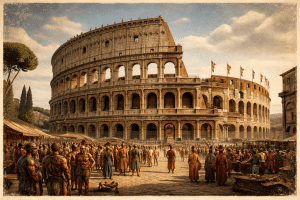
The Colosseum, originally known as the Amphitheatrum Flavium, was completed in 80 CE under Emperor Titus. It could hold more than 50,000 spectators and remains one of the greatest architectural achievements of the ancient world. Built from stone and concrete with advanced engineering techniques, it was a testament to Rome’s technical sophistication and organizational capacity.
More than an arena, the colosseum was a political stage. Gladiatorial games, animal hunts, and public executions were sponsored by emperors to reinforce authority and maintain popularity. The events held within its walls reflected Roman hierarchy: senators closest to the arena, citizens above, women and lower classes higher still.
This physical arrangement mirrored the structure of Roman society itself—orderly, hierarchical, and controlled.
The Military Foundation Behind the Spectacle
The wealth that financed the Colosseum came from conquest. Roman military victories brought resources, slaves, and political stability that allowed emperors to invest in monumental architecture. Without the disciplined Roman legions, the Colosseum would never have existed.
Understanding this link between arena and army is essential. The same empire that organized thousands of soldiers into precise formations also organized massive public spectacles with similar efficiency. Both required discipline, logistics, and hierarchical command.
In this sense, the colosseum was not separate from the army—it was an extension of Roman military success transformed into civic ritual.
What Is a Museum of the Roman Legionary?
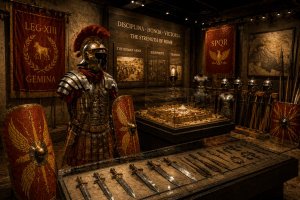
A museum of the roman legionary is dedicated to preserving and interpreting the material culture of Rome’s soldiers. Such museums display weapons, armor, tombstones, inscriptions, and reconstructed equipment that illustrate how legionaries lived, fought, and served.
While the Colosseum shows Rome’s public face, a museum of the Roman legionary reveals its internal structure. Visitors encounter the gladius, pilum, scutum, helmets, and body armor that defined Roman combat. They learn about military ranks, camp construction, engineering works, and the daily life of soldiers stationed across the empire.
These museums bridge the gap between myth and historical evidence.
Legionaries and Gladiators: A Necessary Distinction
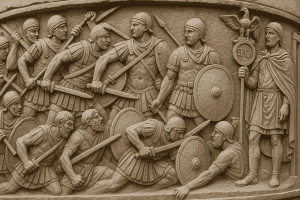
Although the Colosseum is often associated with gladiators, it is important to distinguish them from legionaries. Gladiators were trained entertainers, often slaves or volunteers seeking fame. Legionaries were professional soldiers serving long terms of disciplined military service.
A museum of the Roman legionary highlights this distinction clearly. Through artifacts and inscriptions, visitors can see that legionaries were builders, engineers, and administrators—not merely fighters. Their role extended far beyond combat.
By comparing the Colosseum and the museum of the Roman legionary, one sees two different expressions of Roman strength: spectacle and structure.
The Role of Engineering and Logistics
Both the Colosseum and the Roman army depended on engineering mastery. Legionaries were trained to build roads, bridges, fortifications, and camps. The same technical expertise that allowed Rome to dominate battlefields also enabled the construction of massive monuments.
A museum of the Roman legionary often emphasizes these engineering achievements. Displays may include tools, architectural fragments, and reconstructions of military camps. These exhibits reveal that Roman power was built as much with shovels and measuring rods as with swords.
The Colosseum itself stands as evidence of this military-engineering tradition.
Cultural Memory and Modern Interpretation
Today, the Colosseum remains one of the most visited monuments in the world. Its image is instantly recognizable and deeply embedded in global culture. Meanwhile, museums dedicated to Roman legionaries preserve the artifacts that explain how that culture was created.
Why the Connection Matters
The connection between the colosseum and a museum of the Roman legionary reminds us that spectacle rests on structure. Public entertainment was possible because military discipline ensured stability. The arena celebrated Roman dominance; the legionary enforced it.
Studying both dimensions reveals the complexity of Roman civilization. Rome was not simply violent or imperial—it was organized, methodical, and deeply invested in symbolism.
Understanding this relationship transforms our perception of the Colosseum from a site of isolated brutality into a reflection of broader imperial systems.
The Continuing Fascination
The fascination with the Colosseum and Roman soldiers endures because they represent extremes of human organization: massive architecture, disciplined armies, and ritualized combat. These elements speak to universal themes of power, order, and identity.
For those seeking deeper insight into Roman military culture, historical reconstruction, and visual interpretation, exploring both the Colosseum and resources inspired by a museum of the Roman legionary is essential.
To discover more about Roman military history, visit Res Militares.
FAQ:
What is the connection between the colosseum and the Roman army?
The Colosseum was funded and supported by Roman military success, and its spectacles reflected imperial power established by disciplined legions.
What can you learn in a museum of the Roman legionary?
A museum of the Roman legionary displays weapons, armor, inscriptions, and reconstructions that explain how Roman soldiers lived, trained, and fought.
Why are the colosseum and Roman legionaries still important today?
They represent Roman engineering, military discipline, and cultural symbolism, influencing modern views of power and spectacle.