Throughout history, few military images have captured the imagination quite like that of the Roman legionaries — disciplined, battle-hardened soldiers standing shoulder to shoulder behind their shields. Their courage and organization made the Roman Empire an unstoppable force for centuries. It is no surprise that artists across ages have immortalized them in countless forms of Roman legionaries art — from ancient reliefs and mosaics to modern paintings and digital reconstructions.
These depictions are more than just art. They are windows into how Rome saw itself — as a civilization of order, strength, and endurance. In this article, we’ll explore how Roman legionaries were portrayed in ancient and modern art, what these images tell us about their identity, and why their artistic legacy still resonates today..
The Origins of Roman Legionaries in Art
From the early Republic to the height of the Empire, Roman artists used visual imagery to celebrate military triumphs. Reliefs, statues, and wall paintings often featured the legionary as the ultimate symbol of Roman authority. These works were not only decorative but political — expressions of power meant to inspire loyalty and awe.
One of the earliest and most iconic examples of Roman legionaries art can be seen in the Ara Pacis Augustae (Altar of Augustan Peace) in Rome. Carved around 9 BCE, its friezes depict soldiers and officers among processions, symbolizing the peace and order established through military strength. Even here, the Roman legionary is more than a fighter — he is a guardian of civilization itself.
Sculpture and Reliefs: The Idealized Soldier
The Column of Trajan
Perhaps the most famous monument celebrating Roman military art is the Column of Trajan, erected in 113 CE to commemorate Emperor Trajan’s victories in Dacia (modern Romania). The column’s spiral frieze, nearly 200 meters long, is a masterpiece of Roman legionaries art.
Every inch of it tells a story — soldiers crossing rivers, building fortresses, fighting enemies, and presenting captured kings. The details are so precise that historians have identified armor types, weapons, and even hairstyles used by the legions. The figures move in disciplined order, embodying the efficiency that made the Roman army legendary.
Arch of Titus and Other Monuments
The Arch of Titus in Rome also features legionaries carrying spoils from the Jewish Temple after the siege of Jerusalem (70 CE). These carvings were designed not just to commemorate victory but to demonstrate the unity and might of Roman soldiers serving under divine authority.
Such monuments functioned as state propaganda, glorifying the legions as the physical embodiment of Roman values — courage (virtus), duty (pietas), and discipline (disciplina).
Mosaics and Frescoes: Everyday Art of the Roman Soldier
While monumental sculpture captured the glory of the state, mosaics and frescoes brought the image of the legionary into homes and public spaces. In villas across the empire — from Pompeii to North Africa — archaeologists have found vivid mosaics showing Roman soldiers in battle or parade.
In Pompeii’s House of the Faun, for instance, the famous Alexander Mosaic (though depicting a Greek battle) reflects the Roman obsession with military heroism and valor — ideals embodied by their own legions. Later works from Britain, Gaul, and the Eastern provinces display legionaries on horseback or in triumphal processions, blending realism with symbolism.
Such images show how Roman legionaries art evolved from pure propaganda to cultural identity. The soldier became both protector and model citizen — an image that Roman families were proud to display in their homes.
Portraiture: The Faces of the Legion
Roman funerary art also offers a more personal perspective. Tombstones of legionaries, often found along the empire’s frontiers, depict soldiers standing proudly with their shields and swords. These stone reliefs reveal not idealized heroes but real men — complete with wrinkles, scars, and individual features.
One of the most touching examples is the tombstone of Caius Largennius, discovered in Strasbourg. The carved portrait shows a soldier of the Second Legion, equipped with his gear, his name and years of service etched beside him. These monuments are intimate expressions of pride and identity — a common soldier immortalized as part of the Roman story.
Such funerary carvings remain among the most authentic sources of Roman legionaries art, bridging the gap between imperial glory and human experience.
Roman Legionaries in Medieval and Renaissance Art
After the fall of Rome, the image of the legionary did not vanish. Medieval manuscripts and Renaissance paintings revived the Roman soldier as a symbol of authority, discipline, and divine order.
Renaissance artists such as Raphael, Piero della Francesca, and Giulio Romano reinterpreted Roman military themes to celebrate civic virtue. The Roman legionary became the model of the ideal citizen-soldier, loyal to state and faith alike.
Artists studied ancient reliefs and armor fragments to reconstruct the appearance of the legions. This renewed fascination laid the foundation for the academic discipline of classical archaeology — and for later historical painters who sought to recreate ancient battles with accuracy.
Modern and Contemporary Representations
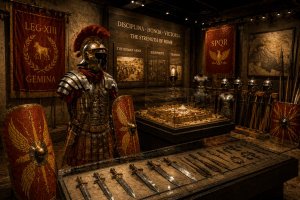
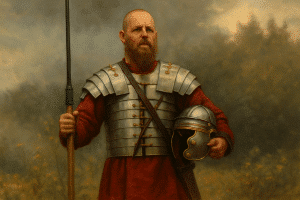
Today, Roman legionaries art continues to thrive in paintings, films, video games, and museum exhibitions. Modern artists draw from archaeological discoveries and ancient texts to recreate the realism of Rome’s military life.
Digital reconstructions and 3D modeling have brought a new dimension to the depiction of legionaries, allowing historians to visualize their uniforms, camps, and battles with unprecedented precision.
Websites such as Res Militares offer in-depth studies and visual archives dedicated to Roman warfare, showcasing the artistry behind armor, weapons, and military organization. Through accurate art and digital renderings, the past becomes tangible again.
Symbolism and Meaning in Roman Legionary Art
Beyond aesthetics, the art of Roman legionaries carried deep symbolic meaning. Every depiction — whether a relief, mosaic, or statue — communicated ideals that Rome held sacred: strength, loyalty, unity, and sacrifice.
The legionary’s stance, often firm and upright, represented order in contrast to chaos. His armor symbolized civilization’s protection. His calm expression, even in scenes of combat, reflected the Roman concept of self-control — virtus through discipline.
Artists used these visual codes to remind viewers that Rome’s greatness depended not just on conquest, but on the character of those who fought for it.
The Legacy of Roman Legionaries in Art and Culture
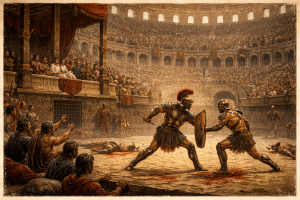
The artistic image of the Roman legionary has endured for over two thousand years. It appears on coins, statues, murals, and even national emblems across Europe. In popular culture, the figure of the Roman soldier continues to represent courage and order — from classical sculptures to cinematic epics like Gladiator.
Museums and galleries around the world, from the British Museum to the Louvre, display masterpieces of Roman legionaries art. Each piece tells a story — of victory, of empire, and of humanity’s enduring fascination with Rome’s disciplined warriors.
At Res Militares, you can explore how these artistic depictions evolved and what they reveal about the soldiers who built the empire’s foundation stone by stone.
From marble reliefs to digital paintings, Roman legionaries art reflects humanity’s enduring admiration for discipline, courage, and unity. The legionary stands not just as a soldier, but as a symbol of Rome’s genius — its ability to turn war into art and men into legend.
Through centuries, artists have captured the spirit of the Roman army in every medium imaginable. Each sword, shield, and sculpted face tells part of the same story: how ordinary men, bound by duty and faith in their empire, became immortal through art.
Discover more about their world — from authentic depictions of armor and weaponry to reconstructions of famous battles — at Res Militares, your gateway to the visual and historical legacy of the Roman legions.