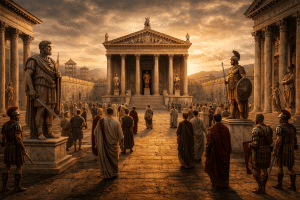
Roman swords were among the most important weapons of the ancient world. Carried by legionaries across Europe, North Africa, and the Middle East, these blades helped Rome expand, defend its borders, and impose military discipline on a vast empire. More than simple tools of war, they represented the organization, training, and tactical intelligence that made the Roman army so effective.
From the short and deadly gladius to the longer spatha of the later Empire, Roman blades evolved with the needs of the army. Their design was never random: every weapon had a role within a larger military system based on formation, discipline, and efficiency. To understand these weapons is to understand the soldiers who carried them and the army that changed the course of history.
For readers interested in Roman military history, equipment, and historical reconstructions, Res Militares offers a deeper journey into the world of legionaries, warfare, and ancient military culture.
Roman Swords and the Military Genius of Rome
The success of roman swords depended not only on craftsmanship, but on the way they were used. Roman soldiers did not usually fight as isolated warriors seeking personal glory. They fought as part of a disciplined unit, protected by large shields and trained to move together under strict command.
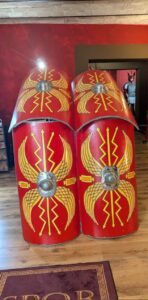
The most famous weapon was the gladius, a short sword designed mainly for thrusting. Its compact size made it ideal for close combat, especially when used behind the protection of the scutum, the large rectangular shield carried by legionaries. In the tight spaces of battle, a short thrusting weapon was often more effective than a long blade requiring wide movements.
Before closing with the enemy, legionaries often threw the pilum, a heavy javelin designed to disrupt shields and formations. Once the enemy line weakened, Roman soldiers advanced with shields forward and swords ready. This combination of missile attack, formation discipline, and controlled close combat made the Roman legion one of the most formidable fighting forces of antiquity.
The Gladius: Rome’s Iconic Blade
The gladius became the symbol of Roman infantry power during the Republic and early Empire. Its origins were influenced by weapons encountered in the Iberian Peninsula, where Rome fought fierce wars against skilled local warriors. The Romans adapted and improved what they found, turning the blade into a standard weapon of the legions.
A typical gladius had a double-edged blade and a sharp point, making it effective for both cutting and thrusting, though Roman tactics favored the thrust. This method allowed soldiers to strike quickly while staying protected behind their shields. It was simple, brutal, and efficient.
The strength of the gladius was not just in the weapon itself, but in the training behind it. Legionaries practiced repeated movements until they became instinctive. In battle, discipline mattered more than decorative swordplay. The Roman soldier was trained to survive, hold formation, and defeat the enemy through precision and unity.
The Spatha and the Changing Roman Army
As the Empire changed, so did its military equipment. Over time, the longer spatha became increasingly common, especially among cavalry. Eventually, it was adopted more widely by infantry as well.
The spatha usually had a longer blade than the gladius, giving soldiers greater reach. This was useful in different combat situations and reflected changes in Roman recruitment, tactics, and battlefield conditions. By the later Empire, the spatha had become one of the dominant military swords.
This transition shows one of Rome’s greatest strengths: adaptation. The Roman army was traditional, but not static. When new weapons, tactics, or equipment proved useful, Rome adopted them. This flexibility helped the empire remain militarily effective for centuries.
Craftsmanship and Production
Producing weapons for such a large army required skill and organization. Roman military workshops created blades, helmets, armor, and other equipment for soldiers stationed across the empire. While surviving examples show regional variations, the Roman system relied heavily on standardization.
A sword had to be durable, balanced, and practical. It needed to survive long campaigns, harsh weather, repeated use, and difficult storage conditions. For a legionary, a reliable blade could mean the difference between life and death.
Some surviving weapons also show decorative details, inscriptions, or carefully crafted fittings. These remind us that military equipment was not only functional, but also connected to identity, rank, and pride.
Symbolism and Power
Weapons in Rome carried meaning beyond the battlefield. A sword could symbolize military authority, citizenship, discipline, and imperial power. Emperors and commanders were often depicted with military equipment to emphasize their connection to the army.
For the legionary, the sword was part of a complete identity. It belonged to a world of training, loyalty, hardship, and service. Alongside the shield, helmet, armor, and standards, it represented membership in one of the most disciplined military systems in history.
This is why roman swords continue to fascinate modern audiences. They are not only ancient weapons; they are symbols of Rome’s ability to organize violence into a system of conquest, defense, and political authority.
Archaeology and Modern Reconstructions
Archaeological discoveries have helped historians understand how these weapons were made and used. Swords have been found in forts, rivers, graves, and former battle zones throughout the Roman world. Each discovery adds detail to our understanding of Roman military life.
Modern reconstructions also play an important role. By recreating blades, armor, and battlefield equipment, researchers and reenactors can test weight, balance, and practicality. This helps transform ancient objects from museum pieces into tools that can be understood in their original context.
At Res Militares, visitors can explore Roman military culture through historical content, visual reconstructions, and detailed studies of legionary equipment.
Why These Weapons Still Matter
The legacy of roman swords is closely tied to the legacy of Rome itself. These weapons helped soldiers conquer territories, defend frontiers, and maintain imperial order. Yet their importance comes from more than violence. They reveal how Rome combined technology, training, logistics, and discipline into a powerful military system.
The gladius and spatha were effective because they served a clear tactical purpose. They were tools designed for soldiers who fought together, followed commands, and trusted the structure of the legion.
Studying them allows us to see the Roman army not as a myth, but as a complex institution built on practical choices and relentless discipline.
Roman swords remain among the most iconic weapons of antiquity because they represent the strength and intelligence of Rome’s military system. From the compact gladius of the legionary to the longer spatha of the later Empire, these blades evolved with the army that carried them.
Their story is not only about combat. It is about craftsmanship, discipline, adaptation, and identity. Through them, we can better understand the soldiers who built and defended one of history’s greatest empires.
Step into the world of the Roman legions by visiting Res Militares, where Roman weapons, legionary life, and historically accurate reconstructions come together in an immersive experience.
FAQ:
What were the most important Roman swords?
The most important examples were the gladius, used widely by legionaries during the Republic and early Empire, and the spatha, which became more common in the later Roman army.
Why was the gladius so effective?
The gladius was short, sharp, and ideal for close combat. It worked perfectly with Roman shield tactics and disciplined formation fighting.
Did Roman swords change over time?
Yes. Roman military blades evolved as tactics, enemies, and recruitment patterns changed, with the longer spatha eventually becoming more common.