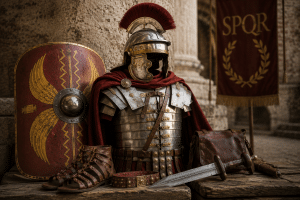
The Roman legionary shield, known in Latin as scutum, represents the emblem of discipline and power of the Roman army, evolving from a simple protective disc to an advanced tactical weapon. Discovering how this artefact transformed over the centuries offers not only a journey into military history but also concrete insights for choosing historically accurate replicas. We will analyze its chronological evolution, construction materials, dimensional variations, tactical uses, decorative symbolism, and finally provide a practical guide to purchasing and maintaining authentic replicas for collecting and reenactment.
What is the historical evolution of the Roman legionary shield?
The roman legionary shield underwent several technical-tactical metamorphoses from the monarchy through the Late Empire, passing through the Republic and Early Empire. Each typology reflects wartime needs, material availability, and strategic innovations. This chronological overview introduces the main transitions that led to the iconic rectangular scutum.
What were the initial round shields like the Clipeus and Oplon?
The first shields of the monarchical and republican periods were round, derived from Etruscan and Greek traditions.
- Structure: multiple glued wooden planks, covered in leather and reinforced with metal bands.
- Dimensions: diameter varying between 60 and 90 cm.
- Function: simple protection, individual use in loose formations.
These shields tended to wear out quickly and provided constructive insights for the adoption of more protective shapes, paving the way for the oval Republican scutum.
How is the oval Republican Scutum characterized?
The Republican scutum introduced an oval shape that combined frontal coverage and tactical flexibility.
| Period | Shape | Height | Width |
|---|---|---|---|
| Republican Age | Oval | 100 cm | 75 cm |
| Tactical Use | Intercepting enemy spears and supporting aligned formations |
The vertical curvature facilitated the deflection of blows, while the oval profile maintained a balance between protection and mobility. This innovation allowed for the consolidation of tight formations in the battles of the last Republican century.
The Evolution of the Roman Shield: From Clipeus to Republican Scutum
Polybius, a Greek historian of the 2nd century BC, describes the Republican scutum as a convex and oblong shield, with dimensions of approximately 120 cm in height and 75 cm in width. Its construction involved two layers of superimposed wooden planks, glued with oxhide glue and externally covered with linen and calfskin, featuring a central boss. This evolution followed the abandonment of the round clipeus of Greek origin.
This research supports the article’s assertion about the evolution of Roman shields, from early round shields like the clipeus to the oval Republican scutum, providing details on materials and dimensions described by ancient historians.
Why is the rectangular Imperial Scutum the symbol of the legion?
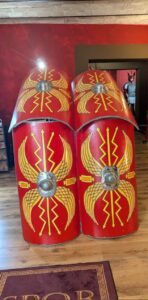
The rectangular Imperial scutum is distinguished by its reduced width and greater height, with rounded edges and an inward-curving shape.
- Curvature: improves lateral protection and allows use in cohesive formations.
- Tactical function: a key element in the testudo formation.
- Protruding boss (umbo): protects the center and serves as a striking tool.
Adopted in the Augustan era, this Roman legionary shield became an identifying symbol of the legion, recognizable also by its standards and painted decorations.
The Rectangular Imperial Scutum: The Dura Europos Find
The only surviving semi-cylindrical rectangular Roman shield, dated to the mid-3rd century AD and found at Dura Europos, measures 105.5 cm in height by 41 cm in width. It is constructed from three layers of wooden strips, with a total thickness of 4.5-6 mm, and covered with painted fabric and leather. This type of roman legionary shield was fundamental for the testudo formation, offering superior protection against projectiles and attacks.
This archaeological find and related analyses confirm the characteristics and dimensions of the rectangular Imperial scutum described in the article, highlighting its structure and protective function, including its importance in the testudo formation.
What changes did shields undergo in the Late Empire?
In the Late Empire, the Roman legionary shield returned to more compact oval or round shapes to adapt to smaller armies and more agile tactics.
- Reduced dimensions improved maneuverability.
- Return to round shapes for light infantry and auxiliary troops.
- Simplified decorations reflected financial and logistical needs.
This evolution illustrates the flexibility of the Late Antique army in adapting armament to geopolitical changes.
Materials, Umbo, and Late Empire Shields in Epitoma rei militaris
Publius Flavius Vegetius Renatus, a Roman official of the 4th-5th century AD, in his work “Epitoma rei militaris,” provides details on the organization and equipment of the Roman army, drawing from older sources. His work describes the importance of the metallic umbo for deflecting blows and as a striking weapon. In the Late Empire, archaeological findings indicate a return to larger and more compact oval or round shields, often with bronze or leather edgings, to adapt to new tactical and logistical needs.
This historical source and modern analysis support the article’s sections on construction materials, the function of the umbo, and the evolution of shields in the Late Empire, providing historical and documentary context.
What materials and techniques define the construction of the Roman legionary shield?
The architecture of the scutum combines wood, leather, and metal in a composite layer that maximizes strength and lightness. In its construction, each component meets precise defensive and tactical requirements.
What are the main materials: wood, leather, and metal?
The primary structure utilizes linden or willow wood, covered in bovine leather and reinforced with iron or bronze strips.
| Material | Characteristic | Advantage |
|---|---|---|
| Wood | Light and flexible | Reduces fatigue and allows maneuvers |
| Leather | Tear-resistant | Maintains integrity between impact and wear |
| Metal | Perimeter reinforcement or boss | Increases ability to repel direct blows |
This combination of materials offers high durability and low weight, essential for the legionary’s mobility.
What role does the umbo (boss) play in the Roman shield?
The umbo, a metallic boss fixed at the center, serves a dual defensive and offensive function.
- Defense: deflects spears and javelins, preventing wood perforation.
- Attack: used as a pushing and ramming tool in close combat.
Variants in solid bronze or hardened iron determine weight and robustness, adapting to individual and mass combat techniques.
Why are edgings and reinforcements fundamental?
Metallic or thickened leather edgings protect the shield’s margins and counteract wear from impact.
- Protection of joints between wooden planks.
- Increased resistance to lateral impacts.
- Preservation of the original shape over time.
These reinforcements ensure that the roman legionary shield maintains mechanical integrity even after many battles, reducing necessary maintenance.
What are the dimensions and weight of the Roman legionary shield?
The scutum balances extensive protection and tolerable weight: dimensions and mass change according to eras and legion types to optimize mobility and coverage.
How do dimensions vary across different eras?
The Republican, Imperial, and Late Antique eras introduce slight differences in the proportions of the roman legionary shield:
| Era | Height | Width | Curvature |
|---|---|---|---|
| Republican | 100 cm | 75 cm | Slight |
| Imperial | 110 cm | 65 cm | Pronounced |
| Late Empire | 90 cm | 60 cm | Moderate |
Reductions in the Late Antique period project greater agility, while the Early Empire favored superior coverage in battle.
How much did the shield weigh and how did it affect the legionary’s mobility?
A complete scutum weighed between 8 and 10 kg, a compromise between protection and speed of movement. Excessive weight would have reduced endurance on the march and readiness to respond to attacks, while a too-light shield offered limited protection. This balance allowed legionaries to move quickly over long distances without compromising defense.
How was the roman legionary shield used in battle by Roman legionaries?
The use of the roman legionary shield in action integrated formations, individual tactics, and team maneuvers, dictating rhythms of attack and resistance.
What is the testudo formation and how did it work?
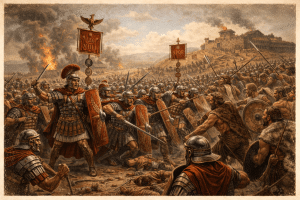
The testudo formation involved legionaries aligned in tight ranks with their shields overlapping to create a continuous protective roof.
- First rank: vertical shields forming a frontal wall.
- Subsequent ranks: overlapping upper margins to armor the advance.
- Tactical advantage: total protection against projectiles and charges.
This tactic allowed legions to approach enemy walls or withstand hostile phalanxes without significant losses, enhancing military discipline.
How did the shield become an offensive weapon?
Beyond passive defense, the roman legionary shield transformed into an impact tool during a charge.
- Coordinated pushes: legionaries gathered strength to break through enemy formations.
- Blows with the umbo: targeted thrusts to the enemy’s face or body.
- Mass pressure: using the shield as a lever to destabilize enemy ranks.
These techniques complemented offensive armament, exploiting the robustness and tapered shape of the umbo.
What is the meaning of symbols and decorations on Roman shields?
The paintings on the shields were visual codes of belonging, motivation, and intimidation, tracing legionary identity and honor.
What were the emblems and colors of the legions?
Each legion adopted a central emblem (lightning bolt, eagle, bull) and distinctive colors (red, yellow, blue).
- Red: symbol of aggression and sacrifice.
- Lightning bolt: evocation of Jupiter and celestial power.
- Bull: strength and resilience.
This iconography allowed for rapid recognition amidst the chaos of battle, strengthening cohesion.
What was the value of historical decorations on shields?
Decorations recounted victories and traditions: engravings of battle dates, Latin mottos, family insignia of centurions. These details increased individual and collective prestige, inspiring courage during clashes and transmitting memories of glory.
How to choose and maintain an authentic replica of the Roman legionary shield?
Purchasing a historical replica requires attention to construction details, aesthetic accuracy, and practical use for reenactments.
What characteristics define a quality replica?
An excellent replica respects:
- Materials are faithful to the original (layered wood, bovine leather, and metal components).
- Thickness and shape conform to historical models.
- Decorations based on archaeological or iconographic sources.
These criteria guarantee authenticity and durability, making the replica usable in reenactment events.
How to care for and maintain Roman shield replicas?
Maintenance includes:
- Drying wood and leather after use to prevent mold.
- Periodic treatment with natural oils to preserve leather elasticity.
- Checking metal reinforcements and tightening rivets.
These practices prolong the life of the replica without altering its historical appearance.
What are the best Roman shield replicas available on resmilitares?
Resmilitares offers a range of shields reproduced according to Republican, Imperial, and Late Antique models, with personalized options for emblems and finishes. Each Roman legionary shield guarantees high-quality materials and archaeologically accurate details for passionate collectors and reenactors.
Where to find resources and further information on the Roman legionary shield?
To delve deeper into the history and evolution of the scutum, it is useful to consult both ancient sources and museum artifacts.
Which ancient historians documented the Roman shield?
Classical authors such as Polybius, Livy, and Vegetius describe the dimensions, tactical uses, and composition of legionary armament, offering details on military practices and the evolution of defensive techniques.
Which museums exhibit original Roman shields or replicas?
Major archaeological museums in Europe, including the National Roman Museum and the Museum of War in Rome, preserve original specimens and reconstructions, participating in interactive educational exhibitions. These collections allow for close study of the weight, raw materials, and authentic decorations.
Directly observing the shields in museum contexts deepens the understanding of the balance between form, function, and symbolism that made the roman legionary shield one of the most celebrated instruments of antiquity.