Trajan’s Column stands in the heart of Rome as one of the most extraordinary monuments of the ancient world. More than a triumphal structure, it is a detailed visual narrative carved in stone, telling the story of Rome’s military might at its peak. Understanding Trajan’s Column means entering the world of Roman legionaries, imperial propaganda, and battlefield reality. This monument does not merely commemorate victory; it preserves, scene by scene, the life, discipline, and organization of the Roman army during the Dacian Wars.
Completed in 113 CE, Trajan’s Column remains one of the most important historical sources for Roman military history, offering unparalleled insight into how Rome fought, governed, and projected power across its empire.
The Historical Context of Trajan’s Column
Trajan’s Column was erected to celebrate Emperor Trajan’s victories in the Dacian Wars (101–102 CE and 105–106 CE), campaigns that secured Rome’s northern frontier and brought immense wealth into the empire. The conquest of Dacia, located in modern-day Romania, was one of Rome’s most significant military achievements of the early Imperial period.
The column originally stood within Trajan’s Forum, a vast architectural complex symbolizing imperial authority. Unlike earlier triumphal monuments, which relied on inscriptions and symbolic imagery, Trajan’s Column adopted an entirely new approach: a continuous sculpted narrative wrapping around the column’s shaft.
This innovation transformed the monument into a permanent visual record of Roman warfare, strategy, and discipline.
Architecture and Design
Standing approximately 30 meters tall (38 meters including the pedestal), Trajan’s Column is constructed from massive Carrara marble blocks. A spiral frieze winds upward around the column, stretching nearly 200 meters if unrolled. The reliefs depict over 2,500 individual figures, including soldiers, officers, engineers, auxiliaries, enemies, and civilians.
Inside the column, a hollow staircase allows visitors to ascend to the top—an architectural marvel that demonstrates Roman engineering expertise. Originally, a statue of Emperor Trajan crowned the column; later replaced by a statue of Saint Peter.
The monument’s scale and complexity reflect the organizational precision of the Roman state, mirroring the discipline of the legions it depicts.
Roman Legionaries in Trajan’s Column
One of the most valuable aspects of Trajan’s Column is its detailed portrayal of Roman legionaries. Unlike idealized heroic statues, the reliefs show soldiers performing everyday military tasks as well as combat operations.
Legionaries are depicted:
- Marching in formation
- Constructing forts and bridges
- Building roads and siege works
- Standing guard
- Engaging in battle
- Conducting executions and negotiations
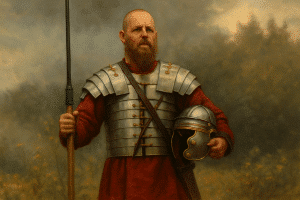
Their equipment is rendered with remarkable consistency, including lorica segmentata, helmets, shields, and weapons. These depictions have become foundational references for historians, reenactors, and artists studying Roman military life.
Trajan himself appears multiple times throughout the narrative—not as a distant godlike figure, but as a commanding presence overseeing operations, addressing troops, and enforcing order.
Warfare Without Chaos
Unlike many later artistic representations of war, Trajan’s Column avoids portraying chaotic melee. Instead, battles are shown as controlled, disciplined encounters. Roman soldiers advance methodically, maintain formation, and dominate through organization rather than individual heroics.
This visual message was intentional. Trajan’s Column presents Roman warfare as rational, justified, and civilizing. The enemy—primarily the Dacians—is shown as brave but ultimately disorganized and inferior to Roman discipline.
This contrast reinforces the ideological narrative that Rome’s victories were not acts of brutality, but necessary steps in bringing order to the world.
Engineering and Logistics on Display
One of the most striking features of Trajan’s Column is the emphasis on non-combat activities. Nearly half of the scenes depict construction and logistics rather than fighting.
Roman legionaries are shown:
- Cutting timber
- Building fortified camps
- Constructing bridges across rivers
- Transporting supplies
- Digging defensive trenches
These scenes highlight a critical truth of Roman military success: victory depended as much on engineering and logistics as on combat.
By immortalizing these activities, Trajan’s Column elevates the Roman soldier from mere warrior to disciplined builder of empire.
Propaganda and Imperial Messaging
Trajan’s Column was a masterpiece of imperial propaganda. Every visual element reinforced the legitimacy of Trajan’s rule and the moral superiority of Roman power.
Trajan is always calm, authoritative, and just. Roman soldiers appear disciplined and professional. Violence, while present, is never gratuitous. Executions are orderly, battles are controlled, and civilians are shown being spared or resettled.
The message was clear: Rome wages war not for destruction, but for stability and prosperity.
This ideological framing helped justify imperial expansion to both Roman citizens and provincial populations.
Trajan’s Column as a Historical Source
For modern scholars, Trajan’s Column is one of the most important visual documents of ancient history. It provides invaluable evidence for:
- Roman military equipment
- Battlefield formations
- Camp construction
- Command structure
- Interaction with enemies
- Daily life of legionaries
While the reliefs are not a photographic record and contain symbolic elements, they remain unmatched in detail and scope.
Many modern reconstructions of Roman armor, weapons, and tactics are directly informed by the imagery carved into Trajan’s Column.
Cultural Legacy and Modern Influence
Trajan’s Column has influenced art, architecture, and historical interpretation for centuries. Renaissance artists studied it closely, and modern museums continue to draw inspiration from its narrative style.
Its legacy endures as a reminder of Rome’s ability to transform war into lasting cultural memory.
Why Trajan’s Column Still Matters
Trajan’s Column is more than a monument; it is a bridge between ancient reality and modern understanding. It preserves the voice of Rome’s army, carved permanently into stone.
Through its scenes, we see not only conquest, but organization, discipline, and ideology. The column explains why Rome dominated the ancient world—not through chaos, but through structure.
For anyone seeking to understand Roman military history, Trajan’s Column remains an essential starting point.
To explore Roman legionaries, military art, and historical reconstructions inspired by monuments like Trajan’s Column, visit our website.
Frequently Asked Questions (FAQ)
What is Trajan’s Column and why is it important?
Trajan’s Column is a Roman monument that depicts the Dacian Wars through detailed reliefs, offering an unmatched visual record of Roman military life and warfare.
What does Trajan’s Column show about Roman legionaries?
Trajan’s Column shows legionaries fighting, building camps, constructing bridges, marching in formation, and maintaining discipline, highlighting their role as both soldiers and engineers.
Where is Trajan’s Column located today?
Trajan’s Column stands in Trajan’s Forum in Rome, near Piazza Venezia.
Why is Trajan’s Column considered propaganda?
Because it presents Roman warfare as orderly, justified, and civilizing, reinforcing the emperor’s authority and the moral superiority of Rome.