Roman Swords and the Power of the Legions
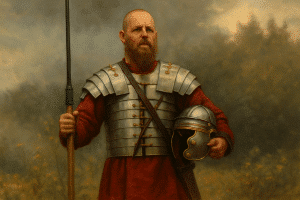
The history of roman swords is deeply connected to the rise and dominance of the Roman Empire. These weapons were more than tools of war; they symbolized discipline, military efficiency, and the tactical superiority that allowed Rome to conquer vast territories across Europe, North Africa, and the Middle East. From the famous gladius carried by legionaries to the longer spatha adopted in later centuries, Roman swords evolved alongside the empire itself.
Understanding roman swords means understanding how the Roman military fought, trained, and adapted to changing battlefield conditions. These weapons were designed not for individual duels or heroic displays, but for coordinated combat within disciplined formations. Their effectiveness helped shape one of the most successful military systems in history.
For readers interested in Roman military equipment, historical reconstructions, and ancient warfare, Res Militares offers detailed insights into Roman arms, armor, and military culture.
The Gladius: The Most Famous of Roman Swords
Among all roman swords, the gladius remains the most iconic. Used primarily during the Republican and early Imperial periods, this short sword became synonymous with Roman legionaries.
The gladius was designed for close-quarters combat. Typically measuring between 60 and 70 centimeters in blade length, it was ideal for thrusting attacks within tight formations. Roman soldiers fought shoulder to shoulder behind large shields, making short, controlled movements more practical than wide slashing strikes.
Its design reflected Roman tactical philosophy. The gladius was not intended for individual showmanship but for disciplined, efficient killing during formation warfare. Combined with the scutum shield and the pilum javelin, it formed the core of Roman infantry combat.
Archaeological finds show several variations of the gladius, including the Mainz, Fulham, and Pompeii types, each reflecting subtle changes in military needs and manufacturing techniques.
Roman Swords in Legionary Training
The effectiveness of roman swords depended heavily on training. Roman soldiers practiced constantly with wooden weapons heavier than real blades, building strength and precision.
Training emphasized thrusting rather than slashing. Roman military writers believed thrusts were deadlier and more efficient in battle. Legionaries learned to maintain formation while striking quickly and accurately.
Discipline played a crucial role. A Roman sword was most effective when used as part of a coordinated military system. Soldiers trusted the men beside them to maintain formation and shield coverage.
This combination of weapon design and rigorous training explains why Roman infantry remained so formidable for centuries.
The Spatha and the Evolution of Roman Warfare
As Roman warfare evolved, so did roman swords. During the later Empire, the spatha gradually replaced the gladius as the primary military sword.
Originally associated with cavalry, the spatha featured a longer blade better suited for wider slashing movements and mounted combat. Over time, infantry units also adopted it, particularly as Roman military tactics adapted to new enemies and changing battlefield conditions.
The rise of cavalry warfare along the empire’s frontiers contributed to this transition. Longer swords offered advantages against opponents fighting with greater mobility.
The spatha would later influence many medieval European swords, demonstrating the lasting impact of Roman weapon design.
Roman Swords and Battlefield Strategy
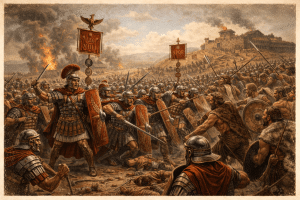
Roman swords cannot be understood separately from Roman tactics. Legionaries fought in organized formations where shields created protective barriers and coordinated movement maximized effectiveness.
Before engaging with swords, Roman troops typically weakened enemy lines with thrown pila. Once formations closed, swords became decisive weapons in brutal close combat.
Roman commanders valued discipline and endurance over reckless aggression. The compact design of the gladius complemented this tactical approach perfectly.
As warfare evolved in later centuries, the longer spatha reflected adjustments in strategy, mobility, and enemy composition.
Manufacturing and Craftsmanship
The production of roman swords required advanced metallurgical skill. Roman blacksmiths developed effective forging techniques that balanced durability and sharpness.
Sword production occurred across the empire, from Italy to frontier provinces. Standardization ensured that legionaries received reliable weapons regardless of location.
Decorative elements also appeared on some swords, especially among officers. Engravings, inlays, and ornate hilts reflected rank and prestige while maintaining practical functionality.
Archaeological discoveries continue to reveal details about how Roman swords were manufactured and maintained.
Symbolism and Cultural Importance
Roman swords carried symbolic as well as military significance. The sword represented authority, discipline, and Roman identity. Officers wore swords as visible signs of command, while victorious generals displayed captured enemy weapons during triumphal processions.
Ceremonial swords also appeared in imperial iconography and religious contexts. In Roman culture, weapons were closely tied to concepts of honor, citizenship, and imperial power.
This symbolic dimension reinforced the prestige of the Roman military system.
Roman Swords in Archaeology and Popular Culture
Today, roman swords remain among the most recognizable artifacts of the ancient world. Museums across Europe display excavated gladii and spathae recovered from forts, battlefields, and rivers.
Modern historical reenactments and artistic reconstructions help bring these weapons back to life. Through accurate reproductions, historians and enthusiasts better understand how Roman swords were used in combat.
Popular culture often romanticizes Roman weapons, but historical evidence reveals a more practical reality. Roman swords were efficient military tools designed for organized warfare rather than individual heroism.
Why Roman Swords Still Fascinate Historians
The enduring fascination with roman swords comes from what they represent: the military discipline and engineering efficiency that defined Roman power.
These weapons influenced centuries of European sword design and remain central to the study of ancient warfare. They provide insight into Roman tactics, manufacturing, and cultural identity.
For those interested in exploring Roman military history further, including visual reconstructions and historical analysis, visit our website.
FAQ:
What were the most famous roman swords?
The most famous roman swords were the gladius and the spatha, both widely used by Roman soldiers during different periods.
Why was the gladius effective in battle?
Its short blade allowed Roman legionaries to fight efficiently in tight formations using thrusting attacks.
Did Roman swords influence medieval weapons?
Yes. The later Roman spatha influenced the development of many medieval European swords.