The effectiveness of roman legionary tactics was one of the primary reasons the Roman Empire expanded across three continents and maintained control for centuries. Roman victories were not accidental nor based solely on numbers; they were the result of structured formations, disciplined coordination, logistical preparation, and strategic flexibility. Understanding roman legionary tactics means understanding how Rome transformed warfare into a calculated system of organization and control.
From the Republican manipular formations to the Imperial cohort system, Roman battlefield methods evolved while maintaining a core principle: cohesion over individual heroics. The legionary did not fight alone; he fought as part of a highly trained machine. For readers interested in deeper historical analysis and visual reconstructions of Roman military methods, visit il sito to explore detailed studies of Roman warfare.
Organization as the Foundation of Roman Legionary Tactics
One of the defining characteristics of roman legionary tactics was organization. Roman legions were divided into smaller, manageable units—centuries and cohorts—that allowed flexible maneuvering during combat. This structure enabled commanders to adapt to terrain and enemy behavior without losing overall cohesion.
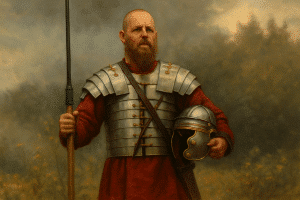
Each legionary understood his position within the formation. The standardized equipment—gladius, scutum, pilum, and armor—allowed soldiers to operate in synchronized movements. Unlike tribal forces that relied on individual strength, Roman units relied on collective discipline.
Communication was maintained through signals, standards, and clearly defined ranks. Orders could be executed rapidly, allowing formations to pivot, advance, or withdraw with precision.
Roman Legionary Tactics in Open Battle
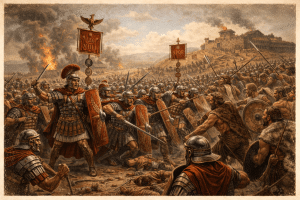
In open battle, roman legionary tactics emphasized controlled aggression. The typical engagement began with the throwing of the pilum, a heavy javelin designed to disrupt enemy shields and formations. Once the enemy line was weakened, legionaries advanced in close formation.
The short sword, or gladius, was optimized for thrusting rather than slashing, making it effective in tight formations. Soldiers protected themselves and their comrades using the large rectangular shield, creating a unified defensive wall.
Reserves were often kept behind the front line. Fresh troops could replace exhausted soldiers, maintaining pressure on the enemy. This rotation system ensured endurance during prolonged engagements.
The emphasis on formation integrity was crucial. Roman soldiers were trained to maintain alignment even under intense attack, preventing gaps that enemies could exploit.
Adaptability and Tactical Innovation
Roman Legionary Tactics Across Different Frontiers
A key reason for Roman success was adaptability. Roman legionary tactics were not static; they evolved depending on the opponent. Against heavily armored foes, Romans relied on disciplined shield formations. Against mobile cavalry forces, they adjusted spacing and support units.
On the northern frontiers, Roman forces confronted Germanic tribes skilled in ambush tactics. In the east, they faced cavalry-heavy armies such as the Parthians. Each environment required modifications to standard practice.
Roman commanders also adapted to terrain. In forests, mountains, or deserts, formation spacing and marching patterns were adjusted accordingly. This flexibility allowed Rome to fight effectively across diverse geographical regions.
The Role of Engineering in Tactical Success
Roman legionary tactics extended beyond battlefield maneuvers. Engineering played a vital role. Roman soldiers built fortified camps at the end of each march, ensuring protection even in hostile territory. These camps were constructed according to standardized layouts, reflecting discipline and order.
Siege warfare was another demonstration of tactical sophistication. Roman armies constructed towers, battering rams, and siege ramps to overcome fortified cities. Rather than relying solely on direct assault, they used systematic pressure and engineering ingenuity.
Logistics further strengthened tactical efficiency. Reliable supply lines ensured that armies remained well-fed and equipped during long campaigns.
Psychological and Strategic Dimensions
Roman legionary tactics also incorporated psychological elements. The sight of disciplined formations advancing in perfect alignment intimidated many opponents. Military standards, armor uniformity, and synchronized movement projected power and control.
Strategically, Roman commanders preferred to choose favorable terrain. They often forced enemies to fight on ground advantageous to Roman formations. Defensive positions, such as high ground or fortified lines, amplified tactical superiority.
Patience was another Roman strength. Commanders avoided unnecessary risk and sought gradual advantage rather than reckless engagement.
Training and Discipline as Tactical Multipliers
Constant training reinforced tactical execution. Legionaries practiced formation changes, coordinated movement, and weapons drills repeatedly. Muscle memory ensured rapid reaction in combat situations.
Discipline was enforced through strict command structures. Disobedience or cowardice carried severe consequences, reinforcing unity. This unwavering discipline ensured that tactical plans were executed effectively.
Roman legionary tactics depended on the reliability of each soldier within the formation. Individual skill mattered, but collective coordination mattered more.
Why Roman Legionary Tactics Still Matter
Modern military doctrine continues to reflect principles established by Rome. Structured hierarchies, combined arms coordination, logistical planning, and disciplined formations remain foundational concepts.
The legacy of roman legionary tactics lies not only in ancient conquest but also in the development of systematic warfare. The Roman army demonstrated that organization, adaptability, and discipline could overcome larger or more individually aggressive forces.
FAQ:
What were roman legionary tactics based on?
Roman legionary tactics were based on discipline, structured formations, coordinated movement, and strategic adaptability.
How did roman legionary tactics defeat larger enemies?
By maintaining formation integrity, rotating troops, and exploiting organization over individual combat.
Are roman legionary tactics still studied today?
Yes. Military historians study roman legionary tactics to understand early models of professional, disciplined warfare.