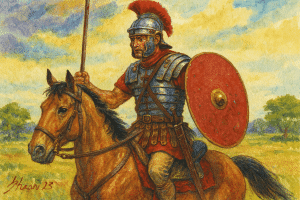
Donning the equipment of a Roman legionary means immersing yourself in the strategy, technology, and discipline that forged an empire. This guide delves into armor, weapons, shields, clothing, and everyday accessories, revealing materials, construction techniques, and tactical advantages. We’ll also discover how the immersive experience at the Res Militares Museum in Rome allows you to touch historically accurate replicas and participate in interactive simulations. Along the way, we will cover:
- The main types of armor and their evolution
- The offensive arsenal of the legionaries
- Shields and defensive formations
- Clothing, marching accessories, and camp life
- The museum experience at Res Militares
- The historical evolution of equipment
- Quick answers to common questions
The Equipment of the Roman Legionary
The equipment of the Roman legionary included armor, weapons, shields, clothing, and accessories, which evolved over time based on tactical needs and technological innovations.
This article provides a comprehensive overview of Roman legionary equipment, covering armor, weapons, shields, clothing, and accessories.
What are the main types of Roman legionary armor?
A legionary’s armor combined protection, mobility, and ease of repair. The structure varied based on materials and period, offering different levels of defense against spears, swords, and arrows. Below, we explore the most common models in use from the 1st century BC to the 3rd century AD.
Roman legionaries used various types of armor, including the lorica segmentata, lorica hamata, and lorica squamata, each with specific characteristics in terms of protection, mobility, and materials.
What is Lorica Segmentata and how was it constructed?
The Lorica Segmentata is an articulated plate armor that protected the torso and shoulders with overlapping iron strips, joined by leather straps and buckles. This system ensured high resistance to impacts and surprising flexibility of movement during close combat. Archaeological findings and reconstructions at the Res Militares Museum demonstrate the precision of the welds and the importance of reinforcements on points of greatest wear, allowing the legionary to maintain speed and agility.
What are the differences between Lorica Hamata and Lorica Squamata?
To highlight the fundamental characteristics of these two types of mail, here is a comparative table that contrasts their structure, materials, and pros and cons.
| Style | Main Material | Protection | Advantage | Disadvantage |
|---|---|---|---|---|
| Lorica Hamata | Interlocking iron rings | High against slashing blows | Repairable in the field | Weight distributed |
| Lorica Squamata | Metal scales sewn onto fabric | Good against blunt weapons | Decorative appearance | Risk of localized breakage |
This analysis highlights how the interlocking mail ensured durability and repairability, while the scale armor offered a balance between defense and aesthetic presentation. We will delve into the evolution of helmets to complete the defensive picture.
How did Roman helmets (Galea) evolve over time?
Early Republican helmets adopted Etruscan models with hemispherical caps.
- Montefortino Type: simple cap and ear protection.
- Coolus Type: more rounded profile and neck guard.
- Imperial Gallic Type: with a central crest, reinforced brim, and shaped neck guard.
These helmets improved visibility, lateral protection, and comfort thanks to internal padding. Progressive ornamentation also signaled rank and legion of origin.
Roman helmets, or Galea, evolved over time, from the early Montefortino models to the more advanced Imperial Gallic, improving legionary protection and comfort.
The article describes the evolution of Roman helmets, highlighting the different types and their characteristics.
What limb protections did legionaries use?
Legionaries protected their arms and legs with:
- Manica: iron plates sewn onto fabric for the forearm.
- Greaves: bronze or iron shin guards shaped to the calf.
- Padded gloves: layers of leather for the hands.
These elements reduced cuts and blunt force injuries while ensuring the necessary mobility to charge with a sword or throw a javelin.
What accessories completed the armor?
In addition to the main protections, the equipment included:
- Focale: a wool scarf around the neck to prevent chafing.
- Subarmalis: a padded gambeson worn under plates or mail to cushion impacts.
- Balteus: a military belt with a decorated buckle, also used to carry the pugio and gladius.
These accessories improved comfort, protection, and allowed legionaries to carry essential tools without restricting movement.
What weapons comprised the Roman legionary’s arsenal?
The standard arsenal balanced close-quarters offensive capability, ranged throwing, and thrusting. Each weapon played a precise role in the combat cycle, an aspect that can still be appreciated today by experiencing the replicas at the Res Militares Museum.
The Roman legionary’s arsenal included the Gladius, Pilum, and Pugio, each weapon with a specific combat role, as well as complementary throwing weapons.
How was the Gladius, the short Roman sword, used?
The Gladius was primarily used for thrusting in tight formations, taking advantage of breaches opened by the pilum. In single combat, it was also used for horizontal cuts. This short blade (40–55 cm) allowed for quick, targeted strikes, maximizing penetration and control of the opponent.
What is the history and use of the Pilum, the throwing javelin?
The Pilum was a 2m javelin with a heavy iron point and a wooden shaft. Its mechanical purpose was to pierce enemy shields and remain embedded, limiting parrying ability and breaking formations. The throwing technique involved a rapid forearm motion and a release while running, optimizing trajectory and penetration.
What were the characteristics of the Pugio, the Roman dagger?
The Pugio measured about 20 cm, served as a backup to the Gladius, and was a status symbol. The hilt, made of bone or inlaid wood, and the triangular blade allowed for deep cuts and thrusts during close combat or in emergency situations.
When and why was the Spatha, the long sword, used?
The Spatha appeared between the 1st and 2nd centuries AD to provide greater reach (up to 75 cm) during campaigns in northern Europe, where cavalry and heavy troops required superior range. The shift from the Gladius to the Spatha reflects tactical changes and the influence of Germanic cultures.
What throwing weapons complemented the equipment?
In addition to the Pilum, legionaries had:
- Sling: leather pouches for lead projectiles.
- Plumbatae: throwing darts hidden inside the shield.
- Light crossbows: issued to support units.
These tools enhanced medium-range offensive potential and disoriented enemy front lines, preparing for close combat.
What were shields like and what defensive tactics did legionaries use?
The shield was the cornerstone of Roman defense, calibrated for formation and individual protection. Each model responded to the needs for coverage and tactical mobility on the battlefield.
What are the characteristics of the Scutum, the iconic Roman shield?
The Scutum was a curved rectangular shield measuring 1.2m x 0.7m, made from glued layers of wood and covered in leather.
- Metal rim for reinforcement
- Central iron boss to deflect blows
- Horizontal grip to maintain formation
This shape allowed for the creation of the famous testudo formation and the simultaneous protection of multiple soldiers.
The Scutum was the iconic rectangular shield of Roman legionaries, designed for protection and formation, while other types of shields were used for different units.
The article describes the characteristics of the Scutum and other types of shields used by Roman legionaries.
What other types of shields did legionaries use?
Other models included:
- Parma: a medium-sized round shield for light troops.
- Caetra: a small round shield used by garrisons in the eastern provinces.
These shields offered greater maneuverability to auxiliary units and during marches or reconnaissance.
How did defensive formations like the Testudo work?
The Testudo was the “tortoise” formation: front ranks raised their shields vertically, while inner ranks held them above their heads. This interlocking shield wall created a continuous screen protecting against arrows and stones, allowing for assaults on walls or crossing exposed areas. Discipline and coordination were essential to maintain cohesion and advance effectively.
What clothing and accessories completed the Roman legionary’s uniform?
In addition to armor and weapons, the legionary wore garments and carried marching gear that influenced their comfort and mobility during campaigns.
The Roman legionary’s uniform included footwear, tunics, cloaks, and military belts, as well as marching equipment (sarcina), which influenced comfort and mobility.
What footwear did legionaries wear?
The Caligae were thick leather sandals reinforced with iron hobnails on the sole. This construction ensured durability, water drainage, and grip on muddy terrain, supporting marches of up to 40 km per day.
How were tunics, cloaks, and military belts made?
The wool tunic covered the torso and reached the knees, while the cloak (paenula or sagum) provided protection from rain and cold. The cingulum militare or balteus was a leather belt with metal pendants, offering abdominal protection and serving as a dagger holder.
What did the sarcina, the marching kit, include?
The sarcina contained:
- Leather backpack with tools (dolabra, service dagger)
- Haversack for food and personal equipment
- Umbrella tent or linen tarp
- Wooden poles for supply
An average load exceeded 25 kg, emphasizing efficiency and logistical organization.
What was daily life like in a Roman camp?
In the castrum, legionaries followed rigorous routines:
- Dawn wake-up for marching and weapons drills
- Construction of fortifications and trenches
- Maintenance of equipment and weapons
- Formation exercises and training with replicas measured at the Res Militares Museum
This constant discipline ensured operational readiness and unit cohesion.
How can you experience the Res Militares Museum in Rome?
The Res Militares Museum offers a sensory journey into the life of a Roman soldier, with artisan replicas, simulations, and virtual reality that expand theoretical knowledge with direct experience.
The Res Militares Museum in Rome offers an immersive experience into the life of a Roman soldier, with historical replicas, simulations, and virtual reality.
How to plan a visit to the Res Militares Museum?
The museum is open daily from 9:00 AM to 6:30 PM at via delle Fornaci 12 – 00184 Rome. Tickets can be purchased online or on-site at full price and reduced rates for under-18s and students, with discounts for groups and schools.
What interactive experiences does the museum offer?
Visitors can:
- Wear Lorica Segmentata and a galea
- Throw a pilum in a protected area
- Try handling a gladius on moving targets
These activities enhance tactical understanding and historical depth, generating educational and emotional engagement.
What does the VR experience of Roman battles consist of?
The VR station immerses you in battle reconstructions (Teutoburg, Dacia) with a 360° view. The simulation integrates sounds, marching orders, and Latin commands, offering an immediate perception of the organization and chaos of warfare.
What historical reproductions and souvenirs can be purchased?
The museum shop offers certified replicas of:
- Pompeii Gladius and Spatha
- 1:1 scale Scutum and Lorica Segmentata
- Bronze jewelry with classical motifs
- Books and educational kits on Roman armaments
Each item comes with a certificate of authenticity and details of artisanal production.
How has Roman legionary equipment evolved over time?
The equipment reflects changes in tactics, metallurgy, and the challenges of different war theaters, from Africa to Northern Europe.
What changes did Marius’s reform introduce to the equipment?
The Marian reforms (107 BC) standardized armament, making the state responsible for providing gladius, scutum, and lorica hamata. This standardized system simplified logistics and training, increasing the effectiveness of the legions.
Marius’s reforms, in 107 BC, standardized equipment, simplifying logistics and training, and increasing the effectiveness of the legions.
The article mentions Marius’s reforms and their impact on the equipment and organization of the Roman army.
How did weapons and armor change between the 1st and 3rd centuries AD?
Between the 1st and 3rd centuries AD, the plates of the lorica segmentata became more refined, the gladius gave way to the spatha, and helmet protection improved. The shift from heavy spears to lighter javelins reflected the need for mobility against nomadic populations.
What influence did the Punic and Dacian Wars have on the equipment?
Defeats and victories in the Punic Wars introduced Carthaginian defensive techniques, while conflicts with the Dacians led to reinforcing plates and shields against powerful bows and heavy axes.
How does the museum illustrate evolution through its collections?
The Res Militares Museum displays replicas of archetypes (Corbridge, Newstead, Pompeian Type) in chronological order, accompanied by interactive panels explaining variations in design and materials. This exhibition path clarifies how tactical needs and metalworking innovations guided every transformation.
What are the frequently asked questions about Roman legionary equipment?
What was the main armor of the Roman legionary?
The Lorica Segmentata dominated torso protection between the 1st and 3rd centuries AD, thanks to overlapping and mobile iron strips that ensured flexibility and resistance.
What weapons did a Roman soldier carry?
A typical legionary was equipped with three fundamental weapons:
- Gladius, a short sword for close-quarters thrusting
- Pilum, a heavy throwing javelin
- Pugio, a reserve dagger
Complementing the offensive kit, he used a scutum and balteus.
Where can I try on Roman armor in Rome?
The Res Militares Museum at via delle Fornaci 12 offers original replicas of lorica, galea, and scutum with protected stations to assess comfort and maneuverability.
How was the pilum thrown correctly?
The pilum was loaded with the dominant hand, cocking the elbow at chest height and releasing forward with a torso rotation to increase speed and penetration.
What was the name of the Roman shield?
The legionaries’ rectangular shield was called the Scutum, designed to cover the soldier’s entire flank and facilitate defensive formations.