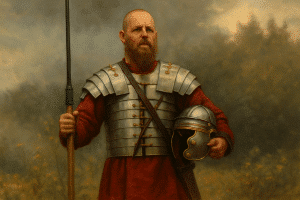
Few images evoke the grandeur and brutality of ancient Rome more vividly than the Roman legionaries and the Colosseum gladiator. One group represented the disciplined military machine that built an empire; the other symbolized the blood-soaked entertainment that thrilled Roman crowds for centuries.
Although legionaries and gladiators served very different roles, their worlds intersected inside the stone walls of the Colosseum. Here, military order met theatrical violence, and the power of the Roman state was displayed for all to see. Understanding this relationship offers a deeper insight into how Rome maintained authority, shaped identity, and crafted one of history’s most enduring spectacles.
This article explores those connections—military culture, public entertainment, political messaging—and brings readers closer to the soldiers and fighters who shaped Rome’s legacy.
The Roman Legionaries: Foundation of the Empire
The Roman legionaries were highly trained professional soldiers who formed the backbone of Rome’s military dominance. Their equipment—lorica segmentata, gladius, scutum, and pilum—was standardized across the empire, reflecting a level of organization the ancient world had never seen.
A legionary’s life was defined by discipline. They served up to 25 years, drilled daily, built fortifications, engineered bridges, and fought in some of the most decisive battles in history. The stability of the Roman world rested heavily on their shoulders.
But legionaries were not only warriors. They were also symbols—living representations of Roman strength, loyalty, and imperial order. Their presence in public events reinforced the authority of the emperor and the power of the state.
This symbolic role is part of what linked them to the world of the Colosseum.
The Colosseum: Arena of Blood and Glory
The Colosseum, or Flavian Amphitheatre, was completed in 80 CE under Emperor Titus. With seating for tens of thousands, it hosted events designed to entertain the public and glorify the empire.
These included:
- Gladiator combats
- Beast hunts (venationes)
- Public executions
- Mock naval battles
- Historical battle reenactments
The Colosseum served as a monumental stage where the emperor demonstrated his generosity, and where Roman societal ideals—valor, courage, endurance—were symbolically displayed.
It was here that the worlds of the Roman legionaries and the Colosseum gladiator visibly converged.
How Legionaries and Gladiators Connected
Though legionaries were elite soldiers and gladiators were mostly slaves or criminals, the two occupied overlapping symbolic roles.
1. Military Presence at the Games
Legionaries often guarded the Colosseum during major events. Their appearance before the crowd, in full armor, reminded spectators of the empire’s military superiority.
Their discipline contrasted sharply with the wild brutality of the gladiators entering the arena, emphasizing that gladiators embodied the chaos tamed by Roman order.
2. Reenactments of Famous Battles
One of the Colosseum’s most spectacular features was its ability to recreate historical battles.
In these performances, legionaries—or actors dressed like them—would re-enact famous victories such as:
- Julius Caesar’s battles in Gaul
- The conquest of Britain
- Roman triumphs in Dacia
- Naval conflicts staged as miniature sea battles
Such reenactments blended education with entertainment, reinforcing pride in Rome’s military past.
3. Legionary Training Reflected in Gladiator Combat
While gladiators trained in ludi under strict instructors called doctores, some of their combat styles resembled legionary techniques. After all, both groups trained with:
- Wooden swords
- Shield drills
- Structured combat stances
The gladius used by legionaries and many gladiator classes (like the secutor) showed direct influence.
4. Veterans Became Gladiators (Rare but Documented)
It was rare, but not unheard of, for disgraced or dishonored legionaries to become gladiators. Desertion, treason, or cowardice could condemn a soldier to the arena—an ultimate humiliation.
In such cases, the public spectacle carried a clear message: discipline must be upheld at all costs.
The Colosseum Gladiator: Hero, Victim, and Symbol
The Colosseum gladiator was a complex figure. Most fighters were slaves, prisoners of war, or criminals. Yet their courage, skill, and dramatic deaths captivated Roman audiences.
Certain gladiators became celebrities—admired, painted on walls, or even used in political propaganda. Their fame sometimes rivaled that of modern athletes.
But while gladiators were adored for their bravery, legionaries were respected for their service.
Together, they embodied two sides of Roman culture:
- The disciplined defender of Rome (the legionary)
- The fearless performer of death (the gladiator)
Both reinforced the empire’s ideals of strength and courage, but in very different contexts.
Gladiator Types Inspired by Rome’s Enemies
In some cases, gladiators represented Rome’s defeated foes. This reinforced the victory narrative that the legionaries had achieved on the battlefield.
Common enemy-themed gladiators included:
- Thracians (Thraex)
- Gauls (Galli)
- Samnites
- Parthians
These fighters used distinctive weapons modeled after their cultures. When they lost in the arena, it symbolically reenacted Rome’s domination—victories originally won by the Roman legionaries.
The Government’s Use of Legionaries and Gladiators
For emperors, both groups were tools of political messaging.
Legionaries
Represented obedience, loyalty, and imperial authority. Their presence legitimized the emperor’s power.
Gladiators
Represented entertainment, generosity, and control over life and death. Their fights kept the population satisfied and distracted.
When the emperor appeared at the Colosseum surrounded by legionaries, watching gladiators fight, the message was clear:
“Rome’s strength is absolute. Its enemies fall before us. Its soldiers protect us. And its ruler commands all.”
Inside the Arena: When Legionaries Participated in Combat
Although gladiators were the stars, there were rare cases when legionaries entered the arena—not to fight each other, but to display military exercises or staged battles.
These events showcased:
- Tactical formations
- Use of pila and shields
- Coordinated battle drills
It was an opportunity for the Roman public to admire the skills that protected their empire.
On a few occasions, condemned criminals were forced to fight legionaries in staged executions. The outcome was inevitable but served as public justice.
The End of the Arena Era
As Christianity spread, gladiator combat was eventually outlawed (official bans came in the 5th century CE). The Colosseum fell into disrepair, and the iconic clashes between the Roman legionaries and the Colosseum gladiator faded into legend.
Yet their stories still fascinate modern audiences. Museums, films, and reenactments continue to revive the world of ancient Rome. Websites like Res Militares help preserve the historical accuracy of these narratives.
Legacy and Modern Fascination
Today, the image of the armored legionary standing in the shadow of the Colosseum remains one of the strongest symbols of ancient Rome.
The contrast between the loyal soldier and the doomed gladiator encapsulates the complexity of Roman society: disciplined yet brutal, orderly yet theatrical.
Their legacy lives on in:
- Historical documentaries
- Reenactment groups
- Digital reconstructions
- Military history websites like Res Militares
Understanding their stories brings us closer to the heart of Roman culture.