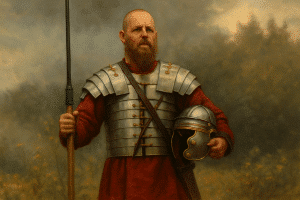
The Colosseum stands today as one of the most recognizable monuments in the world — a symbol of imperial power, architectural genius, and the grandeur of ancient Rome. Yet behind its stone arches and blood-soaked arena lies a deeper story — one connected to the disciplined soldiers who built, protected, and embodied the might of the empire: the Roman legionaries.
To understand the Colosseum fully, one must also understand the men who made it possible. From their role in construction to their presence at imperial spectacles, the legionaries were inseparable from Rome’s military and cultural identity.
The Roman Legionaries: The Empire’s Backbone
The Roman legionaries were the professional heavy infantry soldiers who formed the backbone of the Roman army. Recruited primarily from Roman citizens, they were highly trained, well-equipped, and sworn to serve for up to 25 years.
Clad in their iconic lorica segmentata armor, carrying the curved scutum shield and the deadly short sword gladius, they were the embodiment of discipline and order. Their efficiency and organization allowed Rome to conquer vast territories — but their influence extended far beyond the battlefield.
Legionaries were also builders, engineers, and craftsmen. The same soldiers who fought in Gaul or Dacia also constructed roads, bridges, fortresses — and even monumental structures like the Colosseum.
The Colosseum: Rome’s Eternal Arena
The Colosseum, originally known as the Flavian Amphitheatre, was commissioned by Emperor Vespasian around 72 CE and completed by his son Titus in 80 CE. It could hold an estimated 50,000 to 80,000 spectators, making it the largest amphitheater of the ancient world.
It was not just a venue for entertainment — it was a political statement. The emperors used the Colosseum to demonstrate Rome’s prosperity, power, and generosity toward its people. The games celebrated imperial victories, honored the gods, and reinforced the glory of the empire.
Yet, the construction and operation of such a colossal structure depended heavily on the organizational prowess and manpower of the Roman army.
Roman Legionaries and the Construction of the Colosseum
Although enslaved workers provided much of the manual labor, it was the Roman legionaries who oversaw, organized, and engineered the Colosseum’s construction. Military engineers — specialists drawn from the legions — were essential to the design and logistics of the building process.
1. Engineering Expertise
Legionary engineers applied their battlefield knowledge to architecture. They were experts in mechanics, geometry, and materials, honed through years of constructing forts, bridges, and siege engines. Their understanding of arches, concrete, and drainage systems was crucial to the Colosseum’s durability.
The structure’s complex network of corridors and underground chambers (hypogeum) reflects the same precision seen in Roman military camps. Order, efficiency, and functionality were the guiding principles — all hallmarks of legionary discipline.
2. Organization and Supply
The logistics of building the Colosseum mirrored the organization of a military campaign. Materials such as travertine stone, tufa, and marble were transported from quarries across Italy. Legionaries coordinated these operations, ensuring that the project ran smoothly and on time — a task requiring the same attention to detail that made Rome’s armies unbeatable.
The Legionaries’ Role in the Arena
The connection between Roman legionaries and the Colosseum extended beyond construction. The amphitheater became a stage where Rome’s military power was displayed for all to see.
1. Military Pageantry
At public games (ludi), the presence of legionaries reinforced the emperor’s authority. Soldiers often marched in ceremonial processions, their armor glinting under the Mediterranean sun, a living symbol of imperial might. Their disciplined ranks reminded the crowd of the empire’s strength and the soldiers’ sacrifices.
2. Execution of Enemies and Rebels
The Colosseum was not just for gladiators and beasts. It also served as a grim stage for the execution of Rome’s enemies. Captured rebels, traitors, and prisoners of war were sometimes thrown into the arena as part of elaborate spectacles.
To the Roman public, these events were more than punishment — they were demonstrations of justice and divine retribution. To the legionaries, they were proof of Rome’s unchallenged dominance.
3. Military Reenactments
Among the most spectacular shows were naumachiae (mock naval battles) and staged military reenactments. The Colosseum’s arena could be flooded with water, and miniature ships engaged in combat to entertain the crowds. Legionaries, or trained performers dressed as soldiers, recreated famous Roman victories, glorifying the empire’s military achievements.
These spectacles celebrated not only the emperor’s rule but also the valor of the legions — ensuring that the people never forgot who secured Rome’s greatness.
Discipline and Duty: Legionary Values in Roman Culture
The Colosseum’s design, order, and spectacles all reflected the core values of the Roman legionaries: discipline (disciplina), courage (virtus), and loyalty (fides).
- Discipline: Just as a legion was organized into precise ranks and formations, the Colosseum’s architecture was built with symmetrical order and efficiency.
- Courage: Gladiators and soldiers alike embodied bravery, facing death in the arena or on the battlefield.
- Loyalty: The unwavering devotion of the legions to the emperor and the state mirrored the Roman ideal of loyalty to Rome itself.
The amphitheater thus became a visual and cultural reflection of the army’s virtues — an artistic monument to the spirit of the legionary.
The Colosseum as a Symbol of Power
The Flavian emperors — Vespasian, Titus, and Domitian — all had military backgrounds. Their success depended on the loyalty of the Roman legionaries, and they understood that Rome’s power rested on the army’s strength.
By constructing the Colosseum in the heart of the city, the Flavians sent a clear message: the spoils of conquest built this monument, and the soldiers’ discipline sustained the empire. The massive amphitheater was, in essence, a military victory cast in stone.
Even the materials used to build it — marble from conquered lands, bronze fittings from captured weapons — were symbols of imperial domination. The Colosseum’s grandeur was both an offering to the people and a monument to the army that had earned such triumphs.
The Decline of the Legionaries and the Fate of the Colosseum
As centuries passed, both the Roman legions and the Colosseum saw decline.
By the 4th and 5th centuries CE, the professional army that had once built and protected the empire was weakened by political instability and economic strain. The Colosseum, too, fell into disuse as gladiatorial games were banned and the empire turned toward Christianity.
Yet, even as the structure decayed, its symbolism endured. The Colosseum remained a silent tribute to the discipline, strength, and achievements of the Roman legionaries.
Today, standing amid the ruins, one can almost hear the echoes of marching feet — the soldiers who once shaped history and helped raise one of the greatest monuments ever built.
Legacy and Modern Fascination
The link between the Roman legionaries and the Colosseum continues to captivate historians, artists, and travelers. The image of the armored soldier, the shining helmet, and the mighty arena have become icons of ancient civilization.
Modern reenactments, museum exhibitions, and digital reconstructions — such as those featured on Res Militares— bring these stories back to life, offering audiences a deeper understanding of the men behind the empire.
The Colosseum stands not only as a monument of stone but as a reminder of the discipline and power that defined the Roman world.
The Roman legionaries and the Colosseum are inseparable symbols of Rome’s might — one representing the human strength that built the empire, the other the monumental expression of its glory.
From the disciplined ranks that conquered the known world to the engineers who shaped marble into majesty, the legionaries left their mark on history in every stone of the Colosseum.
Even today, their legacy endures — a timeless reminder that the empire’s greatness was forged not only in battle, but in the enduring spirit of its soldiers.