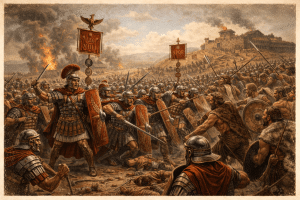
The roman legion vexillum was one of the most important military standards in the Roman army, serving as a symbol of identity, authority, and battlefield organization. Unlike the famous eagle (aquila), which represented the entire legion, the vexillum identified specific detachments and units operating independently. Understanding the roman legion vexillum allows us to better appreciate the discipline, structure, and symbolism that defined Roman military success.
Throughout Roman history, standards were more than decorative banners. They embodied honor, loyalty, and the spiritual identity of a unit. Losing a vexillum was a disgrace; defending it was a sacred duty. Today, the legacy of the roman legion vexillum continues to fascinate historians, reenactors, and military enthusiasts who explore Roman heritage through historical research and visual reconstruction at platforms such as Res Militares.
Structure and Design of the Roman Legion Vexillum
The roman legion vexillum was typically a square or rectangular piece of cloth suspended from a horizontal crossbar attached to a vertical pole. This design distinguished it from other Roman standards, such as the aquila, which featured a sculpted eagle mounted on a staff.
The cloth of the vexillum was often red, symbolizing military strength and sacrifice. It frequently displayed inscriptions identifying the legion or detachment, including abbreviations such as “LEG” followed by the legion’s number. Some vexilla included additional symbols representing victories, honors, or imperial connections.
Unlike modern flags, the vexillum hung vertically from its crossbar, creating a distinctive visual presence on the battlefield. This practical design ensured visibility during marches and combat operations.
Roman Legion Vexillum in Military Organization
The roman legion vexillum played a crucial role in Roman military organization. When a portion of a legion was detached for a special mission, that unit was known as a vexillatio, and it operated under its own vexillum.
This system allowed the Roman army to deploy flexible, independent forces without dismantling the identity of the parent legion. The vexillum functioned as both a tactical marker and a symbolic anchor, maintaining cohesion among soldiers serving far from their main unit.
During campaigns across vast territories—from Britain to the Near East—vexillationes enabled Rome to respond quickly to threats. The vexillum ensured that even detached units preserved discipline, loyalty, and organizational clarity.
Religious and Symbolic Meaning
Beyond its tactical function, the roman legion vexillum held religious significance. Roman soldiers believed that their standards were imbued with protective power. Rituals were performed before campaigns, and standards were often stored in sacred spaces within the military camp.
The vexillum represented more than a unit—it symbolized honor and continuity. Soldiers swore loyalty to the emperor and to their standards. In battle, rallying around the vexillum was both a practical and emotional act, reinforcing unity under pressure.
This deep symbolic importance explains why Roman historians recorded the capture or loss of standards as moments of extreme consequence.
Differences Between the Vexillum and the Aquila
Although sometimes confused, the roman legion vexillum was distinct from the aquila. The aquila was the primary standard of a legion and featured a golden eagle, representing the spirit and destiny of the legion itself.
The vexillum, by contrast, represented smaller formations or temporary detachments. While important, it did not carry the same singular prestige as the aquila. However, its role in battlefield coordination and unit identity made it indispensable.
Understanding this distinction helps clarify the layered structure of Roman military symbolism.
The Roman Legion Vexillum in Archaeology and Art
Archaeological discoveries and relief sculptures provide valuable insight into the roman legion vexillum. Monuments such as Trajan’s Column and the Column of Marcus Aurelius depict vexilla carried proudly by Roman soldiers during campaigns.
Inscriptions found across the Roman Empire confirm the widespread use of vexillationes and their standards. These findings demonstrate how the vexillum contributed to Rome’s capacity for long-term military presence in distant provinces.
Modern reconstructions, including historically informed artwork and detailed visual representations, help bring the vexillum to life. For those interested in exploring Roman military standards, Res Militares offers educational resources and artistic interpretations grounded in historical evidence.
Why the Roman Legion Vexillum Still Matters
The roman legion vexillum remains relevant because it illustrates how Rome combined symbolism with practical military organization. It was not merely a flag; it was an instrument of command, morale, and identity.
Through the vexillum, we see how Roman warfare depended on discipline and cohesion. Each standard unified soldiers under a shared identity, ensuring order across vast and diverse territories.
By studying the vexillum, we gain deeper insight into the mechanisms that allowed Rome to maintain control over an empire that spanned continents.
FAQ:
What was a roman legion vexillum?
A roman legion vexillum was a military banner used to represent a detachment or specialized unit within a Roman legion.
How was the roman legion vexillum different from the aquila?
The aquila symbolized the entire legion, while the roman legion vexillum represented smaller detachments known as vexillationes.
Why was the roman legion vexillum important in battle?
It served as a rallying point, maintained unit identity, and symbolized honor and loyalty during military campaigns.