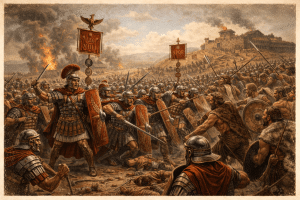
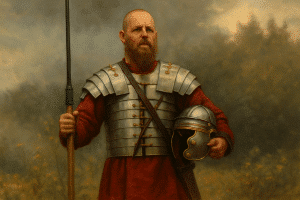
The roman legion uniform is one of the most recognizable images associated with ancient Rome, but the idea of a single standardized military outfit can be misleading. Roman legionaries did share common types of weapons, armour, clothing, and equipment, especially within the same period and unit, yet their appearance changed significantly over the centuries. From tunics and military belts to helmets, shields, swords, and armour, every element reflected the practical demands of campaigning and the organization of the Roman army.
Understanding how Roman soldiers dressed helps us move beyond the cinematic image of identical legionaries and discover a military culture shaped by function, adaptation, rank, climate, and historical period.
What Was the Roman Legion Uniform?
The term roman legion uniform is commonly used today to describe the clothing and equipment worn by Roman legionaries. However, Roman soldiers did not wear a uniform in the modern sense, with every item produced according to a single fixed design.
During the Roman Republic and Empire, military equipment was manufactured in different workshops and could vary according to location, supply networks, period, and individual circumstances. Soldiers nevertheless developed a recognizable military appearance through shared categories of clothing, armour, weapons, belts, footwear, and shields.
A typical legionary of the early Roman Empire might wear a wool tunic underneath body armour, a military belt around the waist, sturdy footwear, and a helmet. He could carry a large shield, a sword, a dagger, and heavy throwing weapons. The precise combination depended on the date and context.
Roman military equipment evolved continuously, which means that the appearance of a legionary under Augustus was not identical to that of a soldier serving several centuries later.
The Tunic: The Foundation of Roman Military Clothing
The basic garment worn by Roman soldiers was the tunica, generally made of wool. It formed the foundation of military clothing and was worn underneath armour.
Modern depictions often show Roman legionaries exclusively in red tunics, but the archaeological and literary evidence does not support the idea that every soldier always wore the same colour. Red was certainly associated with Roman military imagery, yet natural wool shades and other colours were also possible depending on period, region, availability, and production.
Tunics were practical garments rather than ceremonial uniforms. Their cut allowed soldiers to move effectively while marching, training, building fortifications, or fighting.
In colder areas of the Empire, soldiers could also use additional clothing, including cloaks and, particularly in later periods, trousers. Roman military clothing therefore adapted to environments ranging from Britain and the Rhine frontier to North Africa and the eastern provinces.
Armour Used by Roman Legionaries
One of the most distinctive components associated with a roman legion uniform is body armour, but there was never a single type used throughout Roman history.
The lorica hamata, or chain mail, was used for centuries and was valued for its flexibility and durability. The lorica squamata consisted of small overlapping metal scales and was another important form of protection.
Perhaps the most famous Roman armour today is the lorica segmentata, composed of articulated metal plates. It is strongly associated with legionaries of the early Imperial period, particularly from approximately the first to third centuries CE, although historians continue to refine its chronology as archaeological evidence develops.
Different armour types could coexist. Roman soldiers were not necessarily equipped identically, even within broadly similar periods.
Roman Legion Uniform and the Famous Roman Helmet
Helmets are another essential element of the popular image of the Roman legionary. Roman military helmets developed through numerous forms, including types conventionally identified by modern scholars as Montefortino, Coolus, Imperial Gallic, and Imperial Italic.
Early Imperial helmets typically protected the head, cheeks, and neck while still allowing good visibility and hearing. Decorative elements varied, and elaborate crests were not necessarily worn by ordinary soldiers during everyday combat.
Roman centurions are frequently represented with distinctive transverse crests, though the precise use of crests and helmet decoration could vary according to period and circumstance.
These differences are important because there was no single “Roman helmet” used unchanged across hundreds of years.
Shield, Sword, and Weapons of the Legionary
Military appearance cannot be separated from the weapons and defensive equipment carried by the legionary.
The scutum became one of the best-known Roman shields. During the Imperial period it was often large and curved, providing substantial body protection and allowing soldiers to fight effectively in formation. Earlier and later shield designs could differ considerably.
The gladius was the famous short sword closely associated with Roman infantry. Several archaeological types have been identified, including the Mainz, Fulham, and Pompeii forms. During later periods, the longer spatha, initially associated particularly with cavalry, became increasingly common among infantry as well.
Legionaries could also carry the pilum, a heavy throwing weapon designed to be used before close combat, as well as a pugio, or military dagger.
Together, these objects formed an integrated fighting system rather than simply decorative accessories.
Military Belts and Roman Soldier Identity
The Roman military belt, often known through the Latin term cingulum militare, was both practical and visually distinctive. Metal fittings, plates, and pendants could make it one of the most immediately recognizable elements of military appearance.
The belt supported weapons and communicated a soldier’s military identity. Archaeological finds from forts and settlements throughout the former Roman Empire show that military equipment could also carry decorative and symbolic significance.
Footwear was similarly important. Roman soldiers are frequently associated with caligae, open military sandals or boots reinforced with hobnails. They were particularly characteristic of the early Imperial army, although Roman military footwear changed over time.
Even the nickname of Emperor Caligula derived from caliga: according to ancient tradition, he received the childhood nickname because he wore miniature military footwear while accompanying soldiers.
Did Every Roman Soldier Look the Same?
No. The popular image of rows of completely identical legionaries simplifies a much more complex reality.
The Roman army developed strong systems of organization, discipline, and supply, but equipment could vary between periods, units, provinces, and individual soldiers. Archaeological evidence from places such as Vindolanda near Hadrian’s Wall, military sites along the Rhine and Danube, and Roman camps throughout the Empire reveals considerable variety.
Rank also mattered. Centurions, standard-bearers, cavalrymen, auxiliary troops, and ordinary legionaries could be distinguished by aspects of their clothing, equipment, weapons, or insignia.
For this reason, reconstructing a historically plausible roman legion uniform requires identifying a specific chronological period rather than simply combining the most famous pieces of Roman equipment.
Discover Roman Military Equipment Beyond the Images
Museums and archaeological collections remain essential for studying original Roman weapons, armour, inscriptions, and military artefacts. They allow visitors to examine surviving evidence and understand how historians reconstruct the appearance of Roman soldiers.
Res Militares offers a different and complementary approach. It is an immersive experience dedicated to Roman military history and culture, using historically inspired reconstructions, equipment, and interpretive content to help visitors engage more directly with the world of the Roman legionary.
Seeing reconstructed equipment together can make it easier to understand how different elements interacted: how armour fitted over clothing, how a shield was carried, how weapons were positioned, and why military equipment developed in response to practical needs.
If Roman soldiers, legionary equipment, and military life are among the reasons you are exploring ancient Rome, visit Res Militares and experience Roman military history firsthand, discovering historically inspired reconstructions that bring the equipment and culture of the legionaries closer to the modern visitor.
FAQ:
What did a Roman legion uniform include?
A typical roman legion uniform could include a wool tunic, military belt, helmet, body armour, footwear, shield, sword, dagger, and throwing weapons. The exact equipment varied considerably according to period and context.
Did all Roman legionaries wear lorica segmentata?
No. Roman legionaries used different forms of armour, including lorica hamata, lorica squamata, and lorica segmentata. Several types could be used during overlapping historical periods.
Were Roman legionary tunics always red?
Not necessarily. Red is strongly associated with modern representations of Roman soldiers, but available evidence suggests that Roman military tunics could vary in colour. Uniformity was less rigid than modern popular imagery often suggests.