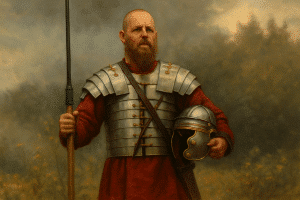
The story of the roman colosseum and gladiators is one of the most powerful and enduring narratives of ancient Rome. More than simple entertainment, the Colosseum and its gladiatorial games represented the political authority, social hierarchy, and cultural values of the Roman Empire. Through carefully orchestrated spectacles, Rome projected dominance, reinforced order, and captivated its population. Understanding the relationship between the Roman Colosseum and gladiators allows us to see how violence, ritual, and public performance became tools of imperial control.
Completed in 80 CE under Emperor Titus, the Colosseum—originally known as the Amphitheatrum Flavium—was the largest amphitheater ever built in the Roman world. Within its walls, gladiators fought not only for survival, but for honor, fame, and the favor of the crowd.
The Colosseum as a Monument of Imperial Power
The Roman Colosseum was far more than an architectural achievement. It was a symbol of imperial generosity and authority, constructed to provide free entertainment to the Roman people. Its massive scale, capable of holding more than 50,000 spectators, demonstrated the empire’s wealth, engineering skill, and organizational capacity.
Every element of the Colosseum was designed to impress. Marble seating reflected social rank, with senators closest to the arena and common citizens seated above. The structure itself reinforced Roman order: everyone knew their place, both physically and socially. When gladiators entered the arena, they performed within a space that embodied the hierarchy of Roman society.
The Colosseum also served as a political tool. Emperors used games to gain popularity, celebrate military victories, and distract the population from unrest. In this way, the roman colosseum and gladiators became inseparable from Roman governance.
Who Were the Gladiators?
Gladiators were not soldiers, despite frequent comparisons with Roman legionaries. They were professional fighters trained specifically for arena combat. Many were slaves, prisoners of war, or condemned criminals, though some were free men who volunteered in search of fame or financial reward.
Gladiators trained in specialized schools called ludi, where they followed strict diets, routines, and combat instruction. Their lives were controlled, disciplined, and physically demanding. Despite their low legal status, successful gladiators could achieve celebrity status, earning admiration, sponsorship, and even romantic attention from the public.
This contradiction—socially marginalized yet publicly idolized—is central to understanding the roman colosseum and gladiators as a cultural phenomenon.
Types of Gladiators and Combat Styles
One of the most fascinating aspects of gladiatorial combat was its variety. Gladiators were divided into classes, each with specific weapons and armor. These pairings were carefully designed to create balanced and visually engaging fights.
Common gladiator types included heavily armored fighters with large shields, lightly armored net fighters relying on speed, and sword-and-shield combatants modeled loosely on Rome’s enemies. The goal was not random violence, but structured confrontation governed by rules and referees.
The emphasis on style, contrast, and technique transformed combat into a form of ritualized theater, where skill mattered as much as strength.
The Spectacle Beyond Gladiators
While gladiator combat is the most famous aspect of the Colosseum, it was only part of a larger program of spectacles. The arena also hosted animal hunts (venationes), executions, and staged mythological scenes.
Exotic animals from across the empire were displayed and killed, symbolizing Rome’s dominance over nature and foreign lands. Executions were carried out as public demonstrations of justice and power, reinforcing social order through fear and spectacle.
These events formed a complete visual narrative of Roman authority, with the Colosseum serving as its central stage.
Violence, Ritual, and Control
The roman colosseum and gladiators reveal how violence was transformed into ritual. Gladiatorial games were not chaotic bloodshed; they were regulated events with clear rules, officials, and outcomes. Death was possible, but not inevitable.
The crowd played an active role, reacting to performances and influencing decisions. This participation created a shared civic experience, binding the population together through emotion and spectacle.
By controlling violence rather than eliminating it, Rome channeled aggression into a controlled environment that reinforced loyalty to the state.
Myths vs Historical Reality
Popular culture often exaggerates gladiatorial combat as constant slaughter. In reality, gladiators were valuable investments, and their deaths were not taken lightly. Many fights ended in surrender rather than death, and skilled gladiators could survive for years.
The Colosseum itself was used intermittently, not daily. Games were expensive and required enormous logistical planning. Understanding this reality allows a more accurate view of the roman colosseum and gladiators as a system rather than pure brutality.
The Decline of Gladiatorial Games
As the Roman Empire changed, so did public values. Economic pressure, political instability, and the rise of Christianity gradually eroded support for gladiatorial games. By the late fourth and early fifth centuries, gladiator combat was officially banned.
The Colosseum did not disappear, but its function evolved. Over time, it became a quarry, a fortress, and eventually a symbol of Rome’s ancient past.
Yet the memory of gladiators endured, shaping how later generations imagined Rome.
The Roman Colosseum and Gladiators Today
Today, the Colosseum is one of the most visited monuments in the world, attracting millions of visitors each year. Modern interpretations—through museums, reconstructions, and historical art—help bring gladiatorial history back to life.
The fascination with the roman colosseum and gladiators remains strong because it touches fundamental human themes: power, survival, spectacle, and identity.
Why This Legacy Still Matters
The roman colosseum and gladiators are not merely remnants of a violent past. They offer insight into how societies use spectacle to express values, control populations, and define identity.
By studying them, we gain a deeper understanding of Rome—and of ourselves.
To explore Roman military culture, visual reconstructions, and historical analysis inspired by ancient Rome, visit our website.
Frequently Asked Questions (FAQ)
What is the connection between the roman colosseum and gladiators?
The Colosseum was the main arena where gladiators performed, making it the central symbol of gladiatorial combat in ancient Rome.
Did gladiators always fight to the death?
No. Many fights ended without death, as trained gladiators were valuable and expensive to replace.
Why are roman colosseum and gladiators still so popular today?
Because they represent power, spectacle, and human drama, themes that continue to fascinate modern audiences.