The column of marcus aurelius rome stands today as one of the most important monuments of the ancient Roman Empire. Located in Piazza Colonna, this towering structure commemorates the military campaigns of Emperor Marcus Aurelius and offers an extraordinary visual narrative of Roman warfare. Although often compared to Trajan’s Column, the column of Marcus Aurelius in Rome possesses its own distinctive character, reflecting a different era, a more turbulent frontier, and a more dramatic style of artistic representation.
To understand this monument is to understand the political and military context of the late second century CE. The column is not merely decorative architecture; it is a carved chronicle of Roman struggle, discipline, and imperial authority.
Historical Context of the Monument
The column of Marcus Aurelius in Rome was erected to commemorate the emperor’s victories during the Marcomannic Wars, fought between 166 and 180 CE. These conflicts took place along the Danube frontier, where Germanic and Sarmatian tribes threatened the stability of Roman territories.
Unlike the earlier and more expansionist campaigns of Emperor Trajan, the wars under Marcus Aurelius were defensive in nature. The empire was facing increasing pressure from external enemies and internal instability. The monument therefore reflects not triumphant conquest alone, but resilience and survival.
The column was likely completed shortly after the emperor’s death in 180 CE, serving both as a tribute and a political message. It reinforced the image of Marcus Aurelius not only as a philosopher-emperor, but also as a capable military leader.
Architectural Structure and Design
Standing approximately 30 meters tall, the column of Marcus Aurelius Rome closely resembles Trajan’s Column in form. It consists of a cylindrical shaft decorated with a spiraling relief frieze that ascends from the base to the top.
The spiral relief contains over one hundred scenes depicting military campaigns, including river crossings, battles, sieges, and acts of imperial clemency. If unwrapped, the relief would stretch nearly 200 meters in length.
Inside the column, a staircase allows ascent to the top platform. Originally crowned by a statue of Marcus Aurelius, the monument now bears a statue of Saint Paul, added during the Renaissance.
Although structurally similar to Trajan’s Column, the artistic tone of the column of Marcus Aurelius is notably more intense and dramatic.
Artistic Style and Emotional Impact
The reliefs of the column of Marcus Aurelius Rome differ significantly from earlier Roman narrative sculpture. Figures are carved in deeper relief, with more pronounced expressions and dynamic movement. The scenes appear more chaotic and emotionally charged.
Battles are depicted with heightened drama. Roman soldiers clash with enemies at close quarters, and the brutality of war is shown more openly. Captives are portrayed with visible suffering, and the devastation of conflict is not concealed.
This shift in artistic style reflects the changing mood of the empire. The second century was a time of crisis, disease, and frontier instability. The column’s imagery captures the urgency and tension of these campaigns.
Roman Legionaries on the Column
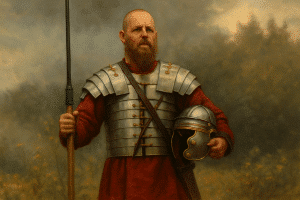
One of the most valuable aspects of the column of Marcus Aurelius Rome is its detailed representation of Roman legionaries. Soldiers are shown marching in formation, constructing fortifications, crossing rivers, and engaging in disciplined combat.
Their armor, shields, and weapons are depicted with remarkable precision, offering historians valuable evidence about late second-century military equipment. The relief scenes show legionaries working together methodically, emphasizing organization and hierarchy.
The emperor himself appears repeatedly throughout the narrative, addressing troops, overseeing sacrifices, and directing strategy. His presence reinforces the idea that imperial authority was inseparable from military leadership.
Symbolism and Imperial Messaging
Like many Roman monuments, the column of Marcus Aurelius Rome functioned as imperial propaganda. It communicated several key messages to the Roman population:
First, it demonstrated that the emperor personally led campaigns and shared in the hardships of war. Second, it reinforced the image of Rome as a disciplined and morally justified power. Third, it reminded viewers of the empire’s capacity to defend its borders.
One particularly famous scene depicts a miraculous rainstorm aiding Roman troops, interpreted as divine intervention. This reinforces the idea that the gods favored Rome’s cause.
The monument thus combines history, religion, and politics in a unified visual narrative.
Comparison with Trajan’s Column
Although both monuments share structural similarities, important differences distinguish them. Trajan’s Column presents war in a controlled and orderly manner, emphasizing engineering and strategic planning.
The column of Marcus Aurelius Rome, by contrast, portrays conflict with greater emotional intensity. The enemies appear more desperate and aggressive, and Roman soldiers are shown in closer, more visceral combat.
This difference reflects broader historical changes. Trajan’s campaigns represented expansion and optimism; Marcus Aurelius faced defensive wars and mounting pressures.
The Monument’s Location and Legacy
Located in central Rome, the column of Marcus Aurelius Rome remains a focal point of Piazza Colonna. Its enduring presence connects modern visitors with the military struggles of ancient Rome.
Over centuries, the monument has survived political change, urban development, and environmental wear. It continues to inspire historians, artists, and tourists alike.
For deeper exploration of Roman military monuments, battlefield representations, and legionary life, visitors can consult historical resources and artistic reconstructions available at Res Militares.
Why the Column Still Matters
The column of Marcus Aurelius Rome is not merely a relic; it is a visual document of imperial resilience. It reminds us that Rome’s survival depended not only on conquest, but on adaptation and defense.
The monument preserves details of military organization, frontier warfare, and imperial ideology that remain essential for understanding late Roman history.
By studying its scenes, modern audiences gain insight into how Rome perceived itself during times of uncertainty and conflict.
FAQ:
What is the column of Marcus Aurelius Rome?
The column of Marcus Aurelius Rome is a second-century monument commemorating the emperor’s victories in the Marcomannic Wars.
How is the column of Marcus Aurelius Rome different from Trajan’s Column?
It features deeper relief carving, more dramatic battle scenes, and reflects a more defensive military context.