Ancient Rome Symbols and Their Importance in Roman Society
The study of ancient rome symbols offers a fascinating window into the values, beliefs, and identity of one of the greatest civilizations in history. Symbols played a central role in Roman life, appearing on military standards, monuments, coins, temples, and public buildings. They communicated power, loyalty, religious devotion, and imperial authority in ways that could be instantly understood by citizens and soldiers alike.
Unlike written texts, symbols transcended language barriers across the vast Roman Empire. Whether displayed on a battlefield, carved into a triumphal arch, or stamped onto official documents, these images reinforced Rome’s political and cultural identity. Understanding ancient rome symbols helps us appreciate how the Romans viewed themselves and how they projected their influence throughout the ancient world.
For those interested in Roman history, military heritage, and historical reconstructions, Res Militares offers an immersive opportunity to explore the visual world of ancient Rome and its enduring legacy.
Ancient Rome Symbols in Military and Political Life
Many of the most recognizable ancient rome symbols originated within the Roman military. These symbols were not merely decorative; they represented authority, honor, and collective identity.
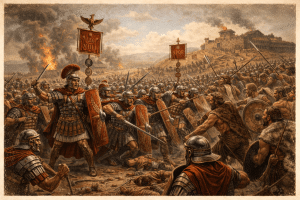
The Roman army depended heavily on visual symbols to maintain discipline and cohesion. Military standards, banners, and emblems allowed soldiers to identify their units and rally during battle. Losing an important symbol could be considered a major disgrace, while capturing an enemy standard was regarded as a significant victory.
Political leaders also understood the power of symbolism. Emperors frequently used symbols on monuments, coins, and official propaganda to strengthen their legitimacy and connect themselves to Rome’s traditions and divine protection.
The Eagle: Rome’s Most Famous Symbol
Among all ancient rome symbols, none was more important than the eagle, known as the aquila. Introduced as the primary standard of the Roman legion, the eagle represented strength, courage, and imperial authority.
Each legion possessed a single eagle standard carried by a specially appointed soldier called the aquilifer. The eagle became the spiritual heart of the legion, and soldiers swore loyalty under its presence.
Because of its significance, the loss of an eagle standard was considered one of the greatest military humiliations. Conversely, recovering a lost eagle became a matter of immense national pride.
The eagle remains one of the most enduring symbols associated with Rome and continues to influence military and governmental iconography today.
The SPQR and Roman Identity
Ancient Rome Symbols and the Meaning of SPQR
Another of the most famous ancient rome symbols is the abbreviation SPQR, standing for Senatus Populusque Romanus—“The Senate and People of Rome.”
SPQR appeared on public buildings, military standards, monuments, and official documents throughout Roman history. It represented the partnership between the Roman state and its citizens, symbolizing the legitimacy of Roman governance.
Even today, SPQR can be seen throughout the city of Rome, appearing on manhole covers, municipal signs, and public infrastructure as a reminder of the city’s ancient heritage.
Its longevity demonstrates the remarkable power of Roman symbolism and its continued influence on modern civic identity.
The Laurel Wreath
The laurel wreath was another important symbol in Roman culture. Associated with victory, achievement, and honor, it was awarded to successful military commanders and celebrated citizens.
Roman emperors were frequently depicted wearing laurel crowns on coins and statues. This visual association reinforced their role as victorious leaders and protectors of the empire.
The laurel wreath also had religious associations, linking military success to divine favor. Over time, it became a universal symbol of excellence that continues to be used in academic, military, and athletic contexts.
The Wolf and the Founding of Rome
Among the most legendary ancient rome symbols is the Capitoline Wolf. According to Roman mythology, the twins Romulus and Remus—the founders of Rome—were raised by a she-wolf after being abandoned as infants.
The image of the wolf nursing the twins became a powerful representation of Rome’s origins and destiny. It symbolized survival, strength, and divine protection.
This iconic image appears in sculptures, mosaics, coins, and modern representations of Roman history. It remains one of the most recognizable visual symbols connected to the foundation of Rome.
Military Standards and the Vexillum
The vexillum was another important military symbol. Unlike the eagle, which represented an entire legion, the vexillum identified detachments and specialized units.
These banners displayed military affiliations and reinforced unit pride. They were carried during campaigns and served as rallying points in battle.
The importance of military standards demonstrates how deeply symbolism was integrated into Roman military culture. Visual identity helped maintain discipline across an empire that stretched across three continents.
Religious Symbols in Ancient Rome
Religion permeated every aspect of Roman life, and many ancient rome symbols had sacred meanings. Images of Jupiter’s thunderbolt, Mars’ weapons, and various temple emblems reflected the close relationship between religion and state authority.
Roman leaders often linked themselves to specific gods through symbolic imagery. These associations strengthened political legitimacy while emphasizing divine support for Roman power.
Temples, altars, and public monuments featured symbolic decoration designed to communicate religious and political messages simultaneously.
Why Ancient Rome Symbols Still Fascinate Us
The continued fascination with ancient rome symbols comes from their ability to communicate complex ideas through simple visual forms. They represent power, unity, faith, victory, and cultural identity.
Many of these symbols remain influential today. Eagles, laurel wreaths, and civic emblems inspired by SPQR continue to appear in military insignia, government institutions, and public monuments around the world.
Studying these symbols helps us understand how Rome built not only a political empire but also a lasting cultural legacy.
To discover more about Roman military history, imperial symbolism, and the fascinating world of ancient Rome, come visit Res Militares and experience Roman heritage through immersive displays and historical inspiration.
FAQ:
What are the most famous ancient rome symbols?
The most famous ancient rome symbols include the eagle (aquila), SPQR, the laurel wreath, the Capitoline Wolf, and military standards such as the vexillum.
Why were ancient rome symbols important?
They communicated authority, identity, military loyalty, religious beliefs, and political legitimacy throughout the Roman Empire.
Can ancient rome symbols still be seen today?
Yes. Symbols such as SPQR and the Roman eagle continue to appear in Rome and influence modern civic and military iconography.